by Steve Wilson
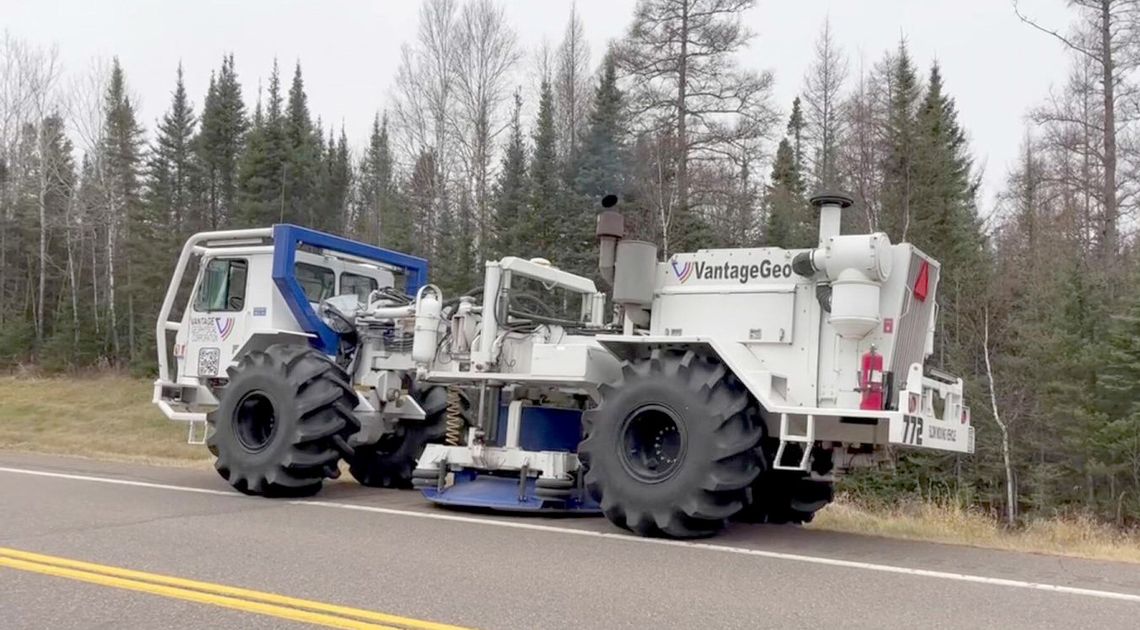
It looked like an oversized moon rover, tricked out with monster-truck tires and a giant suction cup under its frame — not something you expect to see cruising down Hwy 2.
On November 25, I was driving that stretch when the strange vehicle roared down the shoulder and stopped across from me. Curious, I pulled over. The suction cup slowly descended, touched the ground, and almost imperceptibly lifted the vehicle. Then came what felt like my only Minnesota earthquake: the ground vibrated beneath me for several seconds before the mechanism retracted. The rover moved about 100 feet and repeated the process.
After several cycles, I continued on my way, but not before snapping photos and a short video. I suspected this was a seismic vibrator truck, a tool for mineral and subsurface gas exploration. These trucks send controlled seismic waves into the ground; geophones detect the returning signals, revealing underground formations that might hold valuable resources like helium.
Not Pulsar — So Who Was It?
Pulsar Helium, developer of the helium-rich Topaz Project about 25 miles north, had recently received Forest Service approval for a seismic survey along Hwy. 2. Assuming I’d witnessed their work, I sent my video to a Forest Service contact. Days later, I learned it wasn’t Pulsar. Eric Wirz, a Forest Service geologist, confirmed they were scrambling to identify the operator. ‘It’s been an interesting week,’ he said. Asked about a company conducting a survey without the same authorizations Pulsar secured, Wirz called it ‘bizarre’ and ‘a first for me.’ The agency was taking it seriously.
Ted Anderson, Assistant Director of Lands & Minerals at the Minnesota DNR, was equally puzzled. ‘I’m not aware of any [previous seismic surveys without state involvement,’ Anderson said after a long pause.
Pulsar CEO Thomas Abrahams-James admitted he didn’t know who jumped the gun. ‘Based on our success to date, I would not be surprised if we had some admirers,’ he added.
In September, Pulsar Helium entered into an agreement to purchase Quantum Hydrogen, but says it has no interest in hydrogen opportunities.
Helium or Hydrogen?
The timing and location suggest a helium competitor — but no other companies are known to be chasing helium in Minnesota. Seismic testing can also target minerals, but major players in that space are unlikely to operate covertly.
That leaves natural hydrogen, an emerging resource generating global excitement as a clean, carbon-free fuel. The sector is young, but interest is surging. Two companies have zeroed in on Minnesota’s potential: Koloma, a Denver-based startup founded in 2021, has raised about $400 million from investors like Breakthrough Energy Ventures (Bill Gates), Amazon’s Climate Pledge Fund, United Airlines, Osaka Gas, and Mitsubishi Heavy Industries; and Quebec Innovative Materials Corp. (QIMC), which created Orvian Natural Resources LLC to operate in Minnesota.
QIMC’s Moves — and a Hint About Koloma
QIMC CEO John Karagiannidis denied conducting the Hwy 2 survey but confirmed progress on securing two Restricted Geophysical Research Areas (RGRA) from the DNR — about 72 square miles on the Mesabi Iron Range. More permits are expected in Lake and Cook Counties. An RGRA allows exploration for hydrogen, including seismic surveys and drilling. If successful, QIMC could secure a state mineral lease for commercial extraction.
Karagiannidis was bullish: ‘We’re very confident you’re going to find natural hydrogen in Minnesota. The probabilities are very high.’ When I described the Hwy 2 site, he suspected Koloma — ‘their main competitor.’
Permit Trail Leads to Koloma
Lake County has verified granting a utility permit dated August 28. It was verified as a utility permit on county highway rights-of-way only for Toimi Road, Forest Highway 11, and Highway 2, with the stated purpose of conducting a 2D geophysical survey. According to the permit, the survey involved a considerable effort: two VibroSeis Buggies (seismic vibrator trucks), 29 people, 6 UTVs, 7 pickup trucks, and 5 trailers.
The permit listed Iron Range Exploration LLC — nearly invisible online — but a buried email address revealed the truth: @koloma.com.
An email statement in response to inquires from the Lake County Press Koloma said:
“Koloma is excited to be exploring the potential for natural hydrogen in Minnesota. The state’s unique geology and history of innovation make it an ideal place to advance our understanding of this promising clean energy resource. Early indicators show that multiple regions hold significant potential, and our work is focused on gathering the detailed data needed to efficiently and responsibly utilize this natural source of hydrogen at scale.
Natural hydrogen is a cutting-edge energy resource with the potential to reduce industrial emissions and strengthen long-term energy security. Our goal in Minnesota is to build a strong scientific foundation that will guide future development and ensure this resource is used to its fullest potential.
Koloma, through its contractor Vantage Geophysical Corporation, conducted a geophysical survey exclusively on established public road rights-of-way in Lake County, Minnesota, under Permit No. 25-039 that was issued by the Lake County Highway Department. The geophysical survey did not extend beyond the authorized county roads and did not enter or physically disturb any private lands, federal lands, or state-owned surface or subsurface areas. The project was conducted with appropriate traffic control, environmental safeguards, and road authority oversight.
We are excited for the future of natural hydrogen in Minnesota. The early promise we’re seeing reinforces our confidence in this resource and the role it can play in advancing cleaner, more efficient energy solutions. As our work continues, we look forward to building on this momentum and helping shape a strong, sustainable energy future for the state of Minnesota.”
Koloma had sought approval only from Lake County, not from the DNR or the U.S. Forest Service, which typically require permits for such work. Whether a county permit alone satisfies state and federal regulators remains unclear. Forest Service officials say a Special Use Authorization should have been obtained, as Pulsar did.
Anderson of the DNR noted that if Koloma explored only private minerals, no state permit was needed — but doubted they held rights for the entire corridor, which includes a mix of private, county, state, and federal lands. ‘That could be their interpretation,’ he said.
The Bigger Picture
The legal framework for gas exploration is complex, layered, and still evolving. With hydrogen exploration heating up and regulatory gray areas exposed, one thing is certain: This story is far from over.