by Tom Coombe
Legislation that could jumpstart copper-nickel mining projects in northeastern Minnesota has cleared one branch of Congress and now moves on to the other.
The U.S. House of Representatives passed a resolution Wednesday that permanently reverses the Biden Administration’s ban on mining activity in better than 225,000 acres of national forest land.
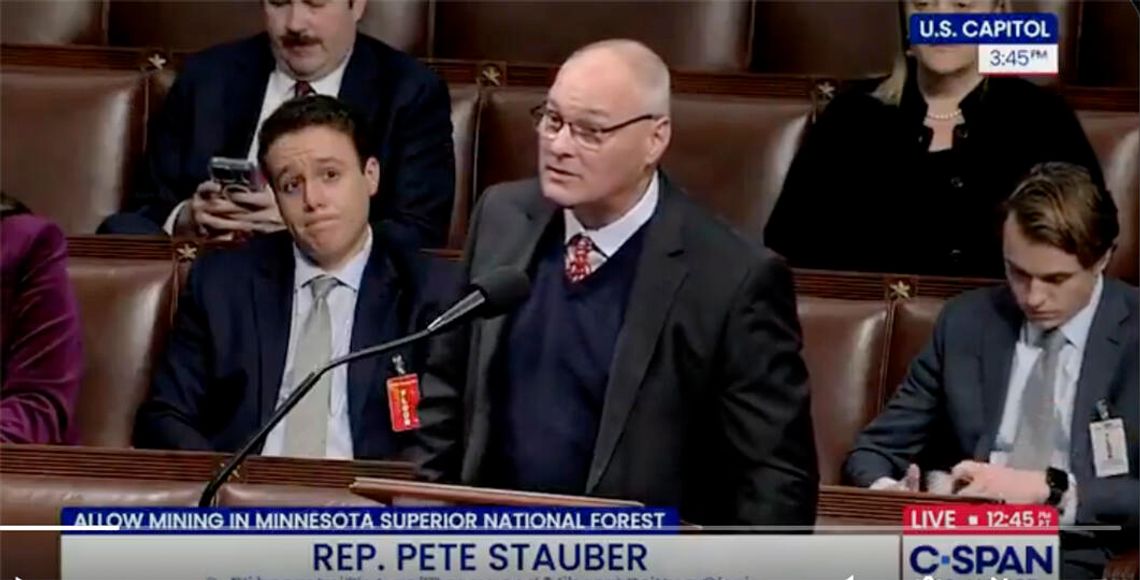
The bill, authored by U.S. Rep. Pete Stauber (R) of Hermantown, was passed on a 214-208 vote and now awaits action in the U.S. Senate.
While the legislation would seemingly revive the Twin Metals Minnesota project planned near Ely, Stauber, in an address prior to Wednesday’s vote, pushed back at the contention that it goes afoul of existing processes.
“This will not green-light any proposed project,” said Stauber. “All it does is remove the dangerous, misguided ban that stops us from considering any project.”
The Twin Metals project faces fierce opposition from environmental interests, who have pressed for a permanent ban on copper-nickel mining in the region and contend it would create pollution and damage the region’s economy.
In an email message to supporters on Wednesday, Chris Knopf, executive director of the Friends of the Boundary Waters Wilderness, said “They voted to hand American public lands to Chilean billionaires. They voted to put the most polluting industry in the United States at the edge of some of the cleanest water in the country. They voted to disregard protections for an American treasure that belongs to all of us.”
While the Senate must still take action, the U.S. House resolution nonetheless marks a major win for those pressing for projects such as Twin Metals, which was stopped in its tracks by a January 2023 order from the U.S. Department of the Interior.
That action reinstated a 20-year mineral withdrawal covering 225,504 acres in the Superior National Forest, banning mining activity and other resource extraction in what has been dubbed a “strategically significant area of the Duluth Complex.”
“It locked up the Duluth Complex and ended this opportunity we had,” said Stauber.
During his address to the U.S. House, Stauber said the area impacted by the mining ban has 33 percent of the nation’s copper reserves, 95 percent of the nickel, 88 percent of the cobalt, 75 percent of the platinum group resources, as well as the largest and most concentrated group of resources.
Stauber also cited the economic impact of proposed mining projects.
“This ban sacrificed thousands of good-paying union jobs that would support families for generations,” he said. “When issuing this ban, the Biden Administration even went so far as to state this was to prevent geothermal exploration and development. The Secretary of the Interior had no idea that the biggest copper-nickel find in the world was in northeastern Minnesota, where she banned mining. It was a dangerous, purely political decision that disregarded the science and disregarded the facts.”
Stauber said he believed the resolution “will allow the facts and science to prevail.”
Over the last decade, prospects for the Twin Metals project and other copper-nickel ventures in Minnesota have gone back-and-forth, depending on which political party was in power.
The Obama Administration issued a mineral withdrawal that was subsequently reversed by the Trump Administration, and then reinstated by the 2023 Biden Administration action, with an order issued by then Secretary of Interior Deb Haaland.
But Stauber charged Haaland failed to comply with the Federal Lands Policy and Management Act, related to Congressional notification of public land orders impacting an excess of 5,000 acres.
Under the Congressional Review Act, that failure appears to give Congress the authority to review and disapprove of actions such as the mining ban
If a CRA joint resolution of disapproval addressing a federal action is passed by both chambers and signed by the President, it is nullified and ceases to have effect, and seemingly requires only simple majorities in both branches of Congress.
That puts the Stauber resolution just 51 Senate votes away from taking effect, which would also prevent the executive branch from taking a substantially similar action in the future.
Stauber has been a persistent advocate for mining in northeastern Minnesota, including proposed Twin Metals Minnesota and NewRange (PolyMet) copper-nickel projects on the east end of the Iron Range.
Momentum related to copper-nickel mining projects has shifted back and forth over the last decade. Proposed copper-nickel mining projects remain the source of contentious debate, with supporters arguing that the projects will bring hundreds of badly-needed, well-paying jobs to the region and bolster the area economy.
Opponents contend the projects are too environmentally risky given the area’s water-rich environment and would do more economic harm than good, ravaging the amenity-based economy and destroying property values.