
Minnesota’s long-standing wild rice sulfate standard is getting another look.
The Minnesota Pollution Control Agency says it’s launching two analyses that will examine the state standard of 10 milligrams of sulfate per liter in waters that produce wild rice.
The action is welcomed by northeastern Minnesota’s taconite industry.
For years, the taconite industry has felt it’s been singled out on the issue.
USW leaders say there’s 965 facilities across the state deemed by the MPCA as potentially requiring sulfate treatment.
“I think the steelworkers are happy the MPCA is taking a fresh look at the science,” John Arbogast, United Steelworkers (USW) District 11 staff representative said. “We hope that they take a look at it with fresh eyes on it.”
The union and taconite industry are united on the issue.
“It’s encouraging to hear that the MPCA is looking into the sulfate standard further and acknowledging it needs more work,” Kristen Vake, Iron Mining Association of Minnesota executive director said. “We are looking forward to hearing how this new work will be applied on the Iron Range where we have naturally occurring sulfate. As we’ve been saying, this is not a mining issue—this is a state of Minnesota issue and we hope the MPCA will continue to look at as such, with fresh eyes and a transparent process.”
Two analyses on the issue will be completed in late 2026, according to the MPCA.
One analysis in partnership with independent researchers will evaluate peer-reviewed science to validate the impacts of sulfate on wild rice, the MPCA said.
Under a second analysis, the MPCA said it will work with academic experts to understand and document the variation in naturally occurring sulfate levels across the state.
When complete, the MPCA said the two analyses could inform the MPCA’s approach to implementing the 10 milligram per liter wild rice sulfate water quality standard.
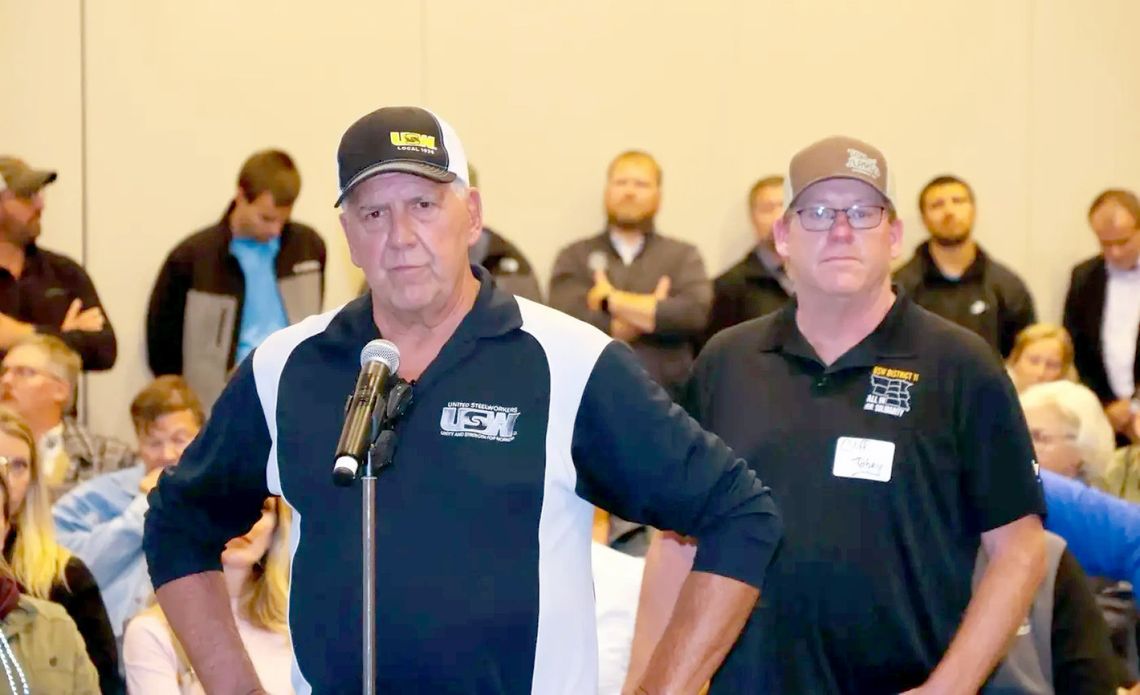
The action comes after a early September public hearing in Virginia on a United States Steel Corp. sulfate level variance request at its Keetac taconite plant in Keewatin.
About 500 area miners, citizens, elected officials, and others, attended the hearing.
A vast majority of attendees criticized the MPCA for its approach on the Keetac variance and the state’s sulfate standard.
“To everyone who submitted comments and showed up to the hearing in September, this shows your voice was heard and your voice matters,” Vake said.
Jake Friend, USW Local 2660 president at Keetac, said the MPCA analyses announcement is “pretty ambiguous.”
Friend says Keetac has until May to meet the 10 milligram per liter standard.
How any new studies may affect Keetac isn’t known, he said.
“We have a lot of questions yet, but we don’t have any answers,” Friend said. “Whether they’re going to hold us to that standard or not, we don’t know.”
Arbogast echoed what steelworkers are feeling.
“We’re going to need some clarification on how this is going to affect the mines, especially Keetac,” Arbogast said. “We’re happy they agency is taking a fresh look at it, but we need clarification on how it will affect the mines.”
Steve Bonach, USW Local 1938 president at U.S. Steel’s Minntac Mine in Mountain Iron, said it’s good that the standard will be examined.
“It needs to be looked at scientifically again,” Bonach said. “All I know is we’re trying to do the right thing up here.”
However, the MPCA said the permitting process will continue while the MPCA conducts the analyses and the 10 milligram per liter standard will remain in place.
The MPCA said will continue to issue permits that protect Minnesotan’s health and the environment.
Potential paths forward for NPDES (water discharge) permits may include a temporary delay in permit development, a permit requirement to monitor for sulfate, or a sulfate limit based on the current water quality standard, according to the MPCA.
Decisions will be made on a caseby- case basis in conversations with permit holders and applicants, the MPCA said.
The U.S. Environmental Protection Agency is aware of the MPCA’s plans to purse the two areas of study, the MPCA said.
Wild rice waters exist across the entire state.
Along with taconite plants, the state’s farm industry, other industries, and municipal wastewater plants across the state, stand to be impacted by the sulfate standard.
Data suggests that naturally occurring sulfate levels vary across Minnesota, the MPCA said.
Sulfate data suggest that natural levels of sulfate in surface waters in southern Minnesota are much higher than natural sulfate levels in surface waters in northern Minnesota, according to the MPCA.
The analysis the MPCA will undertake will center on characterizing natural background levels of sulfate by identifying and, through statistical methods, removing point and nonpoint sources from these sulfate levels to refine maps of naturally occurring sulfate levels across the state, according to the MPCA.
Taconite industry officials say a “one-size-fits-all” standard doesn’t work.
The amount of sulfate naturally contained within the ore that’s mined varies from mine-to-mine, they say.
It can also vary from different sites within a mine, they say.
Because of the differences in sulfate levels within the ore at different taconite mines, taconite industry officials have sought for site-specific standards rather than a single standard for all taconite plants.
The standard was adopted in the 1970s following 1940s findings.
However, up until now, the standard has not been strictly enforced.
Minnesota is the only state to have such a standard.
Some say strict enforcement of the standard is an existential threat to the taconite industry.