Edvin Frederik Hupila was the second born of Joonas Evert Efraiminpoika Hupila and Maria (Sandra) Aleksandra Nicodemuksentytär Kärkelä. His older brother was Atte and younger brother Janne were all older than sisters Lempi and Lyydia.
Though his birth year was not clear until 1970, records were finally found establishing his birth day as April 5, 1887.
Several events out of his control shaped his early life.
Two decades after the great famine of 1866-1888, the Duchy of Finland was just getting back on its feet after losing nearly ten percent of its population. Atte, being the oldest son by two years, meant that he was entitled to inherit the family farm near Kihniö. Russia was still strong as a Tsarist state under Alexander III and Finland, in return, under its control.
Although known as the “Peacemaker,” Alexander’s extreme Russification policies and gradual narrowing of rights both inside and outside of Russia, laid the foundation for underground dissent – leading to the organization of Marxist and Communist tendencies underneath the Monarchy. Though Protestant religion came to the region shortly after the Reformation, the Finns chose to break away from the Church of Sweden and establish its own Church of Finland. Many Christian offshoots formed small congregations throughout the country practicing both conservative and progressive sects.
Edvin realized early on what his lot in life might be.
The farm would never be his, so he was going to have to find his own way in the world. As with a story as old as time, he was at odds with his parents during his early teens. The household was very strict. Joonas was also very religious. He practiced – and became a lay minister - in a small group of fanatics that were similar to what became the “Holy Rollers” in America. Though born “Kirvisniemi,” Joonas wanted to distance himself from the family and changed his surname to “Hupila,” meaning house of joy, to reflect his religious leanings. Young children weren’t allowed at the services, though Edvin and his siblings would at times peek in through the outside windows and would see the congregants in a trance-like state rolling across the floor.
It was not something that appealed to him.
Edvin left home at age 14. That seems too young in our day and age, but many adolescent boys faced with the realities of the time, left their families in their early teens. He spent time at neighboring farms as a laborer. He helped briefly at shops where merchants sold goods. He traveled to northern Finland and worked for some time in the underground mines.
He crossed the Baltic Sea to Denmark and then to Liverpool, England to work as a longshoreman, spending time with other laborers at the seaport docks.
His political beliefs became increasingly radical.
Spending time as a worker/ laborer, the inequity of the immense riches of the Russian ruling class were in stark contrast to the day-today existence of a majority of the population with no such pedigree. Tsar Nicholas II increased the downward pressure by reducing the rights and privileges of the working class, especially after 1901.
Conscription into the Russian army became less of a choice. These factors combined to be the cause for large migrations of people from Russia and Finland to America in the last decade of the nineteenth century into the first two decades of the 20th.
American was a great unknown, but reports coming back to the old country sowed the seeds of what many thought might be a better life. Two major waves from Finland are documented. The first from the 1870s to 1880s came because of the turmoil caused by the Great Famine. The second wave, from about 1890 to the mid 1920s was larger and brought over 200,000 Finns into North America, most to escape the increasing persecution and dwindling economic realities at home. Several had to find out for themselves. Indeed, two members of Edvin’s own family had made the journey to America. Joonas, his father, in 1903 and Atte, his older brother in 1905. Both stayed for less than a year but were there long enough to establish contacts across the Atlantic.
Edvin made three trips across to America. The first when he was 19 in 1906, staying until 1911. Not much is known about his time here during this trip. The ship name does not appear on the passenger list, but his ticket number was 29522 and his occupation was given as “laborer.” He landed in New York and made his way westward, spending time at the mines in the U.P. of Michigan. From there he traveled to Duluth and finally to Stuntz Location in Hibbing. There were some familiar people there. He stayed with the family of Karl Levander, whose wife grew up near Kirvisniemi, the farm back home. Edvin boarded with them for most of the time over these five years. He worked in the mines and then returned to Finland, hoping conditions in the country had improved.
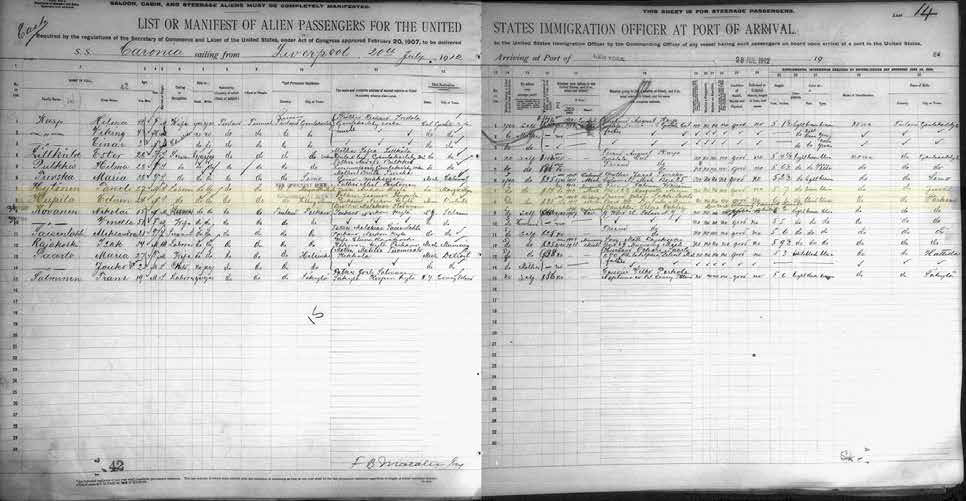
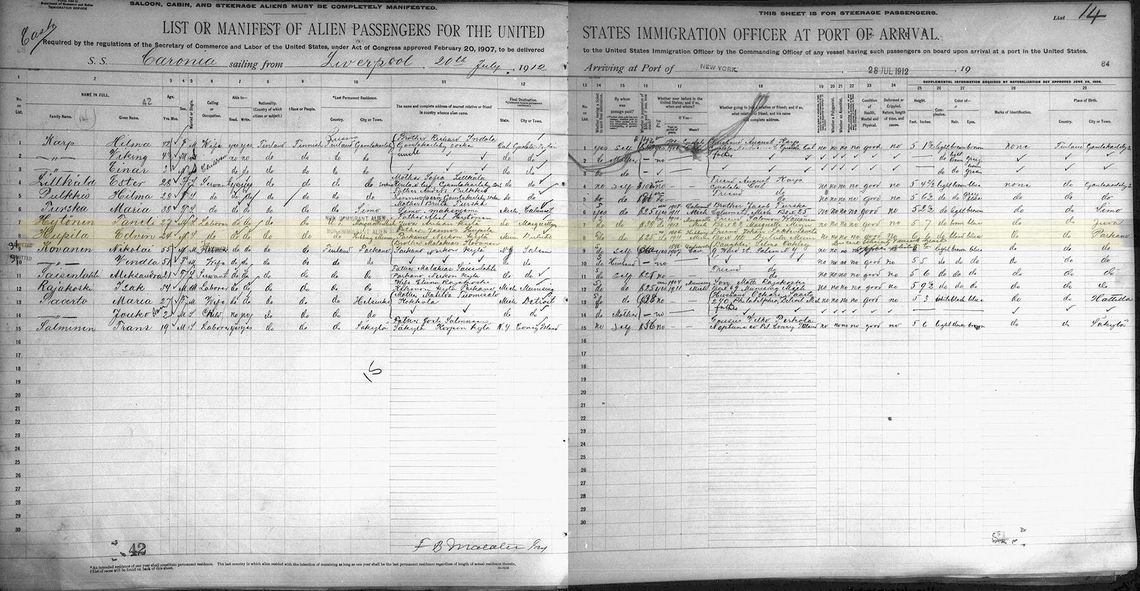
Finding his prospects no better than before, he again crossed to Ellis Island. More is known about this time in America. He left Liverpool on the ship Caronia on July 20 of 1912 and arrived in New York on July 28. Passage cost $25 and he was again listed as a laborer. His destination was Duluth, with a final stop again in Hibbing with the Levanders. He returned to work in the mine.
With no apprenticed skills, he was again relegated to labor.
His stay this time was shorter. Older brother Atte passed away in 1914, and he returned home to become next in line for the Hupila farm.
Besides farming, he also apprenticed as a carpenter during his stay. Having a vocation to back up what might happen in the future was a good idea.
The outbreak of WWI caused many things to happen in a short time. Russia was a major player in this conflict, and conscripts were drafted into the militia in large numbers. Battle losses were staggering. Daily life in the Russian empire became intolerable. Food was in short supply. A terrible economy and the possibility of being called to war while the royal class continued to maintain a luxurious lifestyle above the fray, caused an uprising that eventually resulted in the Russian Revolution in 1917.
The aristocrats were eliminated and the “proletariat” eventually followed Lenin and his communist party to take control over the country.
Finland, for decades seething at the mistreatment by Russia, declared its independence in December of 1917, just a couple of months after the October Revolution. Russia had problems of its own and couldn’t become embroiled in another war with its neighbor. Independence from Russia was accomplished with mere paperwork. However, the same political differences that had been brought to a boil in Russia also were at work in Finland.
Immediately after independence, Finland found itself in civil war.
On one side were the “White” Finns. Landholders and businessmen who were primarily capitalists. On the other side were the “Red” Finns or those who considered themselves socialists.
Edvin fell into the “Red Finn” camp.
It was a short but bitterly fought war. While the Communists prevailed in Russia, the capitalists won in Finland. As mopping up was taking place, Red Finns were not only persecuted, but they were also hunted down and assassinated. Edvin found himself on the run in his own country. He made his final trip to America in 1918, not welcome in Finland anymore.
Younger brother Janne inherited the farm.