Many seasonal residents call Northeastern Minnesota home during summer. Some arrive for the first time this year. Others return year after year.
Every day’s explorations become adventures with unexpected meetings and news.
The weather conditions and resulting wildfires occur as a familiar work environment for hundreds of people who settled in here for the past month, but many experience these forests, lakes, rivers, landscape, and people for the first time. Lots of returning and new visitors fill our days. 2026 provides a new reality layered over a familiar setting. Lots of introductions to carry forward.
In the midst, annual events occur, and some get canceled. Days are filled with routines around special events, anniversaries, new arrivals, celebrations, and unexpected discoveries. Old friends and new friends equal forward-looking relationships.
This may sound like reflections on our social world, but these thoughts extend beyond social, to environmental, political, personal, and cultural developments around us. With what is known now, how will that impact visions for what will be known going forward?
A conversation, a walk, a paddle, some quiet time, etc. will provide opportunities to listen, read, think, discover more about us and what is around us.
When walking the dog, she can be observed and she provides body language but doesn’t say much. She explores and helps find what might go unnoticed. Providing her with new places to visit motivates her enthusiasm and deepens her understanding of how much there is to be appreciated.
Too many examples surround us, and you have those to add to the list. Where should we go next?
This past week, we decided on an afternoon walk to Shagawa Lake at the location of the Ely Wastewater Treatment Plant. This place can be found by describing the route including the west end of Miners’ Lake, the base of Finn Hill, and Stinky Ditch emptying into Shagawa Lake from the plant.
This isn’t a destination for many and therefore provides a quiet place to feel the wind and see the waves lapping the shoreline. Once, years ago, while visiting this area, it happened to have vultures nesting on a rocky ledge hidden along the shore.
It was possible to remember seeing those young vultures, but on this trip, the location couldn’t be recognized. Those were, in a sense, Ely neighbors unbeknownst to anyone.
On this occasion, walking the shoreline with a dog to explore, everything felt refreshing and renewed the relationship with that neighborhood.
Looking up, the movement of a flapping wing near the top of the ledge caught my eye. The young vulture saw me and took cover.
Going back and climbing the slope to the top of the ledge, a perspective looking out over Shagawa Lake and its islands provided a quiet, cool spot on a moss-covered rock. A movement drew notice of a moth caterpillar traveling across the moss leaves.
Like many outings, the unexpected results were out of the expected.
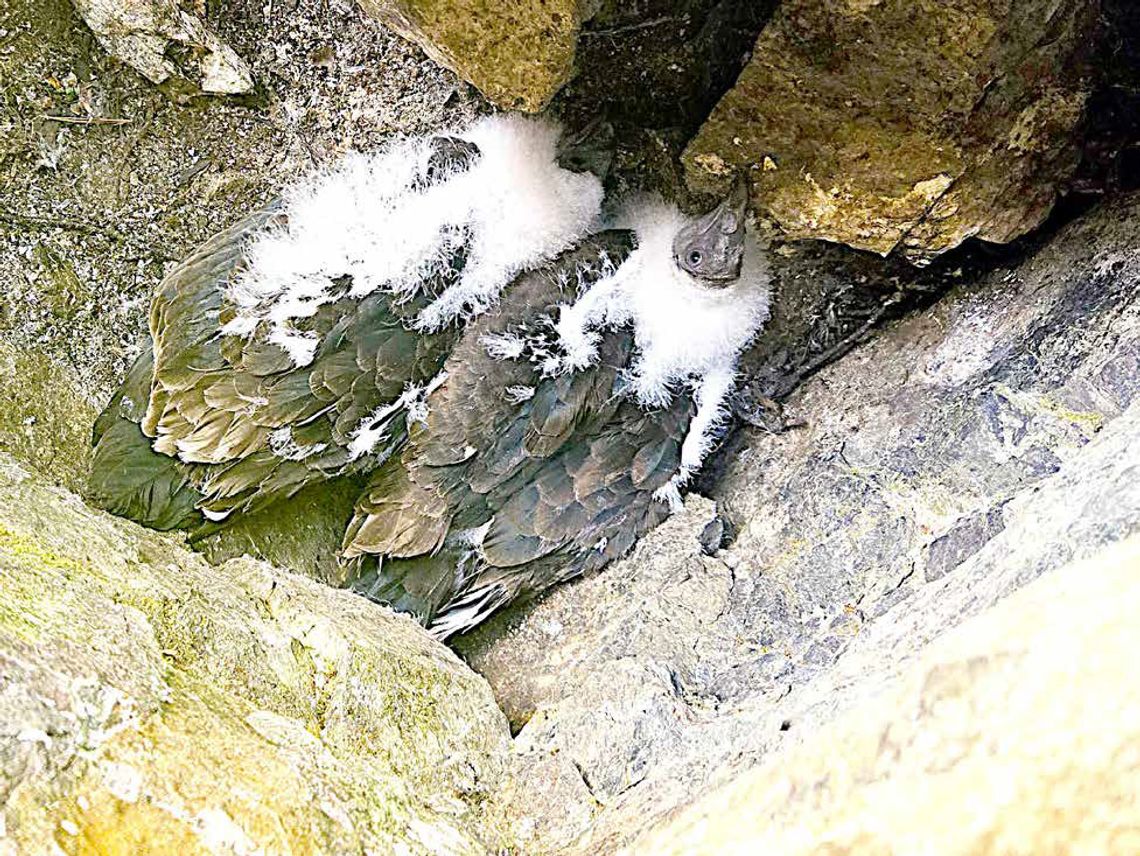
The fractured rocky ledge held residence of two young vultures. Eggs had been laid at the bottom of an opening accessible to adults. The two young vultures were large and going to fledge this month, with potential flight ahead to winter in South America.
F or now, they still had some white downy feathers while their larger black flight feathers were growing. They tried to hide at the bottom of the opening and hissed to dissuade any intruder. The adults had access to the bottom of the opening to come and go, bringing food to regurgitate for them. Like so many living members of our region, plant or animal, human or non-human, historical or living, these two vultures, the caterpillar, the moss, and the ledge rock have a story as neighbors.
Whose story comes next?