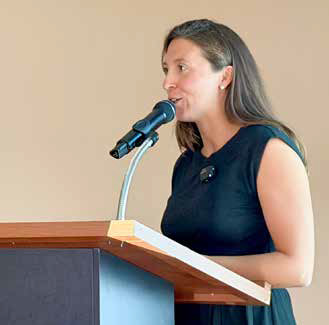
Tuesday Group attendees learned about new Medicaid rules and eligibility details at a presentation on August 11.
Amy Bianco, vice president of federal affairs and strategic initiatives at the Massachusetts Health and Hospital Association, returned to her hometown of Ely to share the information.
Federal shifts in healthcare funding and Medicaid eligibility could impact the 1.3 million Minnesotans enrolled in Medicaid, with some of the greatest impacts felt by rural hospitals.
“We’ve seen it more challenging to access that coverage, as well as more expensive because of recent policy changes,” Bianco said.
Changes have just begun to daylight in hospital systems from federal legislation signed in 2025, and they will continue to unfold until 2030.
Approximately 140 million Minnesotans are expected to lose Medicaid coverage beginning in 2027 due to stricter eligibility requirements.
Medicaid recipients ages 19 to 64 will need to provide proof of work or volunteer commitments totalling to 80 hours per month.
Recipients will need to fill out paperwork every six months to redetermine coverage eligibility, up in frequency from the annual filing currently required.
“This is really the crux of the issue. New work requirements are going to result in people who are working and should be eligible for Medicaid losing coverage simply because of the bureaucratic barriers and administrative barriers that are being put in place for them to access Medicaid,” Bianco said.
Further paperwork will be required of those who qualify for a medical exemption to the work mandate, including proof from the individual’s provider.
An increase in the number of uninsured patients, coupled with $354 million lost in Medicaid revenue, will mean Minnesota hospitals will need to turn up an additional $269 million in charity monies on average to support those patients.
Bianco said 32% of Minnesota hospitals already operate at a deficit, though they are often among the largest employers in many communities.
“From a business standpoint, it’s incredibly impressive that they’re still able to operate,” Bianco said.
With coming federal cuts to Medicaid funding, state Medicaid agencies will not be able to provide support for these facilities as they have in the past.
To compensate, federal legislation also included a provision for the Rural Health Transformation (RHT) Program, which provides $50 billion over five years for distribution to support rural health facilities nationwide.
However, estimates project the losses to these hospitals at $150 billion as a result of cuts, Bianco said, meaning that the RHT may not fully cover the bases for rural healthcare providers.
To supplement the program, some states have introduced automation into their paperwork filing process to make Medicaid access as easy as possible for those seeking coverage.
Bianco said work has commenced with community groups in states like Minnesota and Massachusetts to spread the word about new requirements.
“We are all patients,” Bianco said. “The impacts that we are talking about today are going to impact all of us.”