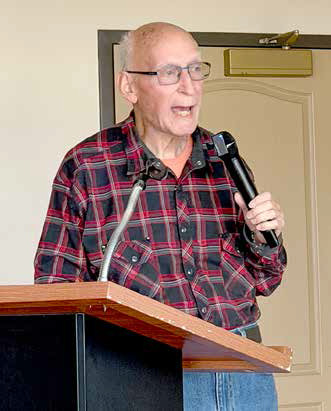
Tuesday Group attendees heard an insider view into aviation strategies for fighting wildfires from former US Forest Service air attack pilot Thomas Clingerman.
Clingerman called the work his “retirement job,” as he began flying on the fires at age 61, after a former student offered him a job as an aerial firefighter.
Clingerman moved to Ely full-time in June 2025 after residing part-time in the area for years. He previously spent many decades in the field of aviation, including 13 years in the Air Force Reserve and time as an instructor pilot.
Clingerman responded to 232 incidents throughout his seven years with the USFS, including work on 171 named fires.
His retirement career took him across the Northwest and southern regions of the United States, where he responded to blazes caused by everything from BBQ grills to arson, windmill service buildings, cigarettes and burned-up oil derrick motors.
Clingerman said the “prize winner” of fire igniters was a cedar log truck in West Texas whose smoke stack lit a log on fire, dropping 10 smoke columns at various intervals along the highway.
Communities in the Northwoods are lucky to have an abundance of water nearby, Clingerman said. In the dry south, pilots search for bodies of water to refill planes and helicopters.
“A lot of times, it’s a farm pond, and you have to ask permission,” Clingerman said. He added that there were several incidents where property owners refused.
He recounted an incident where a rancher adamantly refused the firefighters.
“The guy said, I appreciate what you’re trying to do, and yes, if I lose my range, I’m going to have to haul in hay, but if I lose my water, I lose my herd,” Clingerman recalled.
In addition to dropping water and bright red retardant on forest fires, aerial firefighters coordinate with dispatch centers to receive resources, control air traffic, guide attacks from large air tankers and advise responders on the ground.
The role occasionally involves protection of firefighters on the ground if groups face challenging fire situations, at which point air operations on other areas of the fire will cease in order to concentrate on protection efforts.
Air attack planes range in make and model from helicopters that can “snorkel” water up from a lake into their tanks through a long hose, tankers so large they require a lead plane to map the route in front of them, and amphibious single-engine (SEAT) tankers like some that responded to Ely’s 2026 wildfires.
“We rely a lot on SEATs,” Clingerman said. “You all got to see the new version, the Fire Boss, which is a SEAT on floats.”
Despite seven years in the firefighting cockpit, working 12 hours a day for 12 days straight, Clingerman admits that the number one firefighting tool is a bulldozer.
“When the bulldozers come in, that means you’ve got a major fire,” Clingerman said.
Dozers engage in direct and indirect attack, shoveling dirt over flames or clearing firelines to stop a blaze.
Firefighting may grow increasingly difficult in coming years, Clingerman said, as crews respond to more intense blazes in drier and hotter weather, with fewer water resources and ground saturation due to decreasing winter snowmelt across the country.
Wildland-urban interface also poses a challenge, with communities like Ely located directly in the woods.
“We’ve built houses in the forest, and now we’ve got to protect them from the forest,” Clingerman said.
Clingerman frequently attends Tuesday Group and is often around the community. He encourages individuals to approach him with questions about firefighting.