School looks for relief Big problems, few solutions as board members, state legislators discuss wide assortment of finance related issues facing ISD 696
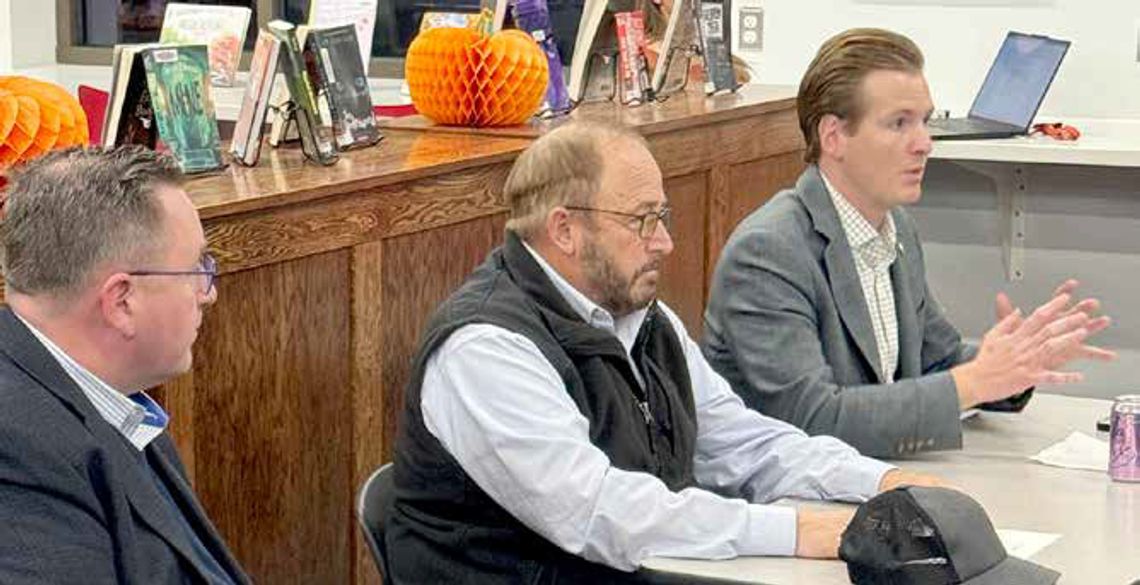
The Ely School District’s precarious financial position was the dominant topic for a rare sit-down between school board members and area legislators.
Both State Sen. Grant Hauschild (D-Hermantown) and State Rep. Roger Skraba (R-Ely) attended Monday’s school board study session and numerous issues - all related to school finance - were on the docket.
School officials lamented lagging revenue streams, some related to declining enrollment while others linked to state aid and student defections to the post secondary enrollment option program or online schooling.
“It seems statewide for the most part, especially rural areas, there’s an education problem with funding,” said school board member Tom Omerza. “The state is not giving us enough money to educate kids.”
The legislators were largely sympathetic while acknowledging the political landscape in St. Paul, and the difficulties associated with ushering in massive changes that would significantly alter the district’s bottom line.
Hauschild said he was hopeful that action could occur “around the margins” that may bring some financial relief, and both he and Skraba support legislation - that failed to advance this year - that would direct more property tax dollars from seasonal recreational properties to the Ely district.
The board was also advised to pursue unlikely alliances - perhaps linking rural districts and Minneapolis and St. Paul schools - to press for change.
“I want you to think about it in a unique way,” said Hauschild. “How can we find out the challenges Minneapolis and St. Paul are facing, and how can we possibly form a coalition of greater Minnesota and Minneapolis and St. Paul. I frankly don’t think we’ll get help from Minnetonka legislators or Edina or Blaine legislators.”
Despite the approval of a $350,000 capital levy, the Ely district has wrestled with budget challenges the last two years, reducing staff through attrition and layoffs and making a series of other cost-cutting moves.
Ely superintendent Anne Oelke said funding for Ely and rural districts overall is “in a funk” and compared it to a family living on a fixed income, while expenses skyrocket. She attributed it to funding not keeping up with inflation over the course of more than a decade.
“Every single cost from staffing, the lights, the utilities, the property, liability insurance, everything has gone up exponentially,” said Oelke. “Inflation has not kept up with the costs.. That is the biggest problem I would say with education funding.”
Omerza had a similar lament and noted difficulties associated with negotiating contracts with school staff.
“I’m sitting at home thinking why is the school district negotiating with AFSCME and the teachers union,” said Omerza. “They should be negotiating with the state legislature because that’s where the money comes from. We don’t have it.”
Board chairperson Rochelle Sjoberg added that districts including Ely have been hit hard by unfunded mandates, including those related to paid time off.
“The amount of unfunded mandates that keep coming down the pike on top of all of this is really brutal,” said Sjoberg.
Sjoberg said she understood the intent of actions taken by the state and added “I can’t tell you how much I appreciate the staff of this district.”
But she added the state mandates are adding further financial stress to the district and “at some point something has to give with these one size fits all mandates - it’s getting out of control.”
Hauschild responded that “when we were passing paid family medical leave, it would be impossible for me morally to vote for that bill and exempt teachers. Providing you more funding to cover those costs ongoing is a huge, huge challenge and I’m committed to keeping the funding stream going to schools, but I don’t know how we exempt teachers from a policy we are passing.”
Hauschild soothed some board concerns and said he believed that the state would continue to provide funding to cover unemployment insurance for employees, such as paraprofessionals, who work only during the school year.
Discussion eventually turned to the PSEO program, which allows high school juniors and students to attend community college, and receive both high school and college credit at the same time.
About 40 current Ely juniors and seniors take advantage of that program, and with them goes the bulk of their state aid, putting further strain on the local district.
Board member Tony Colarich noted the 3.0 grade point average for juniors and 2.5 GPA for seniors needed to take part in the program, and said “those standards need to be tightened up.”
School officials said they understood the rationale for taking part in the program, from schedule flexibility to the opportunity to obtain college credits for free, but Oelke noted that the Ely district must still provide other services including technology and counseling for those students, and that the school also continues to provide and fund extra-curricular opportunities for those students.
Hauschild floated potential remedies, including a state requirement that students may not be able to take a course at a community college if it is also offered at the high school.
“Some of it is taught here, but for college credit, no,” said Omerza. “We don’t have enough teachers that have certification to teach college level classes.”
School officials said that changes in standards and requirements made it unfeasible for high school teachers to obtain the credits they need to also teach college courses.
Skraba said he was concerned with the social aspects related to high school students going to colleges to take courses.
“Here, they’re among their peers,” said Skraba. “Nobody here can go buy a six-pack and take the afternoon off. There you can do that. It takes some of the innocence away. Up there, you’re an adult, you’re no longer a kid.”
Hauschild voiced serious doubts that lawmakers will overhaul PSEO.
“I don’t think there’s a legislative coalition that is willing to make major, major changes to PSEO,” said Hauschild. “There are too many kids benefiting from getting college credits. Are there changes we can make at the margins that could have huge impacts for school districts like yours? I think that’s how we have to approach it. I don’t see a majority of legislators saying we’ll cut access to this overall, it’s how do we do some tweaks that pass muster.”
Oelke also noted the district’s high transportation costs and asked for relief, noting that for students needing special education services in Virginia, the district is funding down-and-back trips by a school vehicle twice each day.
“That’s unheard of in the metro,” said Oelke.
Ely also faces higher costs for extracurricular programs because of its geography, sending buses for hundreds of miles on numerous sports-related trips.
Talk also veered to the revenue side of the equation, and Hauschild’s ongoing efforts to adjust the property tax system to allow for the district to get a chunk of the money paid by seasonal recreational property owners.
“It’s a moral imperative that they pay to our local school districts,” said Hauschild. “Oftentimes these properties are the wealthier properties and they’re not paying to your school district, and it falls on longtime residents who have smaller homes.”
Hauschild said his proposal, which Skraba also endorsed, “creates a new formula that still collects those taxes to the state but provides a reimbursement back to the local school district. At the end of the day, you get the money. Just know we’re not changing the way the tax structure works, just creating a new aid.”
The lawmakers also voiced hope that a proposed helium project in the area would generate new funding for local schools.
Hauschild said he’s committed to legislation creating a helium district that would go by a radius from the proposed operation, and ensure that Ely will obtain tax revenues.
“It’s all still to be worked out,” he said.
“That’s assuming it takes off, and in what decade,” Omerza responded.
Skraba said he hoped that helium operations happen “sooner rather than later,” but voiced concern about possible opposition to the project.
“There’s no mining, yet there’s opposition that it’s going to ruin the woods or something,” said Skraba. “It’s frustrating.”
This marked the first time in at least 20 years that two legislators met with Ely School Board members.
They were joined by lobbyist Jeff Anderson, who is set to return to the board table to firm up Ely’s priorities prior to a session that begins in February.
Board members said they were appreciative of the discussion.
“I look across the table I don’t see (board members) as a D or an R,” said Omerza. “I think the same goes for you guys. I don’t look at Grant and see a Democrat and I don’t think Republican when I think of Roger. I think you are just trying to help us the best you know how and there’s not enough of you at the state legislature and for sure Washington, D.C.”