Iron ore has for more than a century inextricably linked the Iron Range and Duluth.
And a new exhibit being developed at The Depot in Duluth, will reflect iron ore’s importance to the entire region.
“A County Built on Iron,” will educate visitors about the iron mining industry, its history, contributions to communities, the county, state, and nation,” Wayne Gannaway, St. Louis County Historical Society executive director said.
“It’s pretty cool how it’s finally come to pass,” Gannaway said. “The idea and script is that it would be an educational exhibit.”
The Depot for years had “A County Built on Iron,” exhibit Gannaway said.
But it was retired about six years ago with the intent of refreshing it, he said.
It’s taken years to secure funding for a new exhibit, but the exhibit is now heading into the fabrication stage, Gannaway said.
Behind bipartisan support from northeastern Minnesota legislators and the leadership of Ron Hein, a former Erie Mining Co. employee, $385,000 in state bonding was secured several years ago, Gannaway said.
Hein is a member of an Erie Mining Company History Project Team that led research, development, and securing of funding for the award-winning, full-color, 352-page book “Taconite New Life for Minnesota’s Iron Range—The History of Erie Mining Company.”
“JoAnne Coombe (former St. Louis County Historical Society executive director) and I had talked about a small section in the old exhibit for Erie Mining Company,” Hein said. “She said that maybe we need to re-do the whole thing. I’m hoping it will be a catalyst for people to find out more about mining and go to Minnesota Discovery Center or the Minnesota Museum of Mining.”
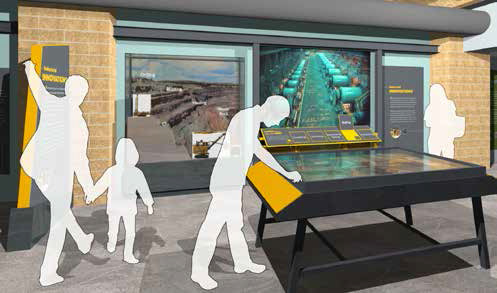
Four sections of the new exhibit will educate visitors on the geology and discovery of natural iron ore, the research and transition to taconite mining, how immigrants shaped Iron Range culture, and the future potential of mining, including copper and nickel, Hein said.
“It’s a destination-type exhibit where people can come and hear about mining from the time it was born to today,” Hein said.
The exhibit is designed to explain the complexity of taconite mining, give visitors a stronger connection to northeastern Minnesota, detail where iron ore comes from, and its role in steel production, Gannaway said.
Iron mining artifacts, panel illustrations, maps, oral histories, and interactive activities will be among highlights of the exhibit, Gannaway said.
It will also outline the discovery of iron ore, the development of communities around iron ore mines, community impacts, scenic impacts, industry challenges, concerns, how regulations play a role in balancing impacts, and how mining might be done in the future, Gannaway said.
“It will provide a very interactive, well-thought out exhibit,” Gannaway said. “In the end, it will not only be a great exhibit, but a good learning environment.”
A vast majority of the iron ore pellets produced at Iron Range taconite plants are shipped down the Great Lakes via the Port of Duluth- Superior.
Iron ore pellets are the primary ingredient used to make steel in blast furnaces.
The longstanding tie between iron ore production on the Iron Range and iron ore shipments from the port benefits both the Iron Range and the Duluth-Superior area.
“Mining has a huge impact on the region,” Shane Peterson, St. Louis County Property Management director said. “Duluth wouldn’t exist without mining.”
The exhibit will be 76 feet-long by 13 feet-wide on the second floor of the St. Louis County-owned Depot, Peterson said.
St. Louis County is serving as the fiscal agent for the project, Peterson said.
“It’s an important story to tell,” Peterson said. “Mining has always had a huge impact on the region.”
St. Louis County, the St. Louis County Historical Society, a Mining Advisory Committee, an American Indian Advisory Committee, and Cleveland-Cliffs Inc., are among partners in the project, Gannaway said.
Split Rock Studios, a Brooklyn Park, MN design agency, is leading design of the exhibit, Gannaway said.
There’s no firm target date for completion of the exhibit and a public opening, Gannaway said.
However, the exhibit might open about a year from now, he said.
The Depot—also known as the St. Louis County Heritage and Arts Center—is undergoing a major renovation project.
The renovation, including replacement of mechanical, electrical, plumbing and heating, ventilation and air conditioning systems, is expected to last two years, according to St. Louis County.
The Depot is on the National Registry of Historic Places. An average of 200,000 people visit The Depot each year.
The Depot has been welcoming visitors to Duluth and St. Louis County since 1892, according to the county. St. Louis County has owned the building since 1977. Tenants include the Lake Superior Railroad Museum, North Shore Scenic Railroad, Duluth Superior Symphony Orchestra, St. Louis County Historical Society, Minnesota Ballet, Lyric Opera of the North, Arrowhead Regional Arts Council, and the Depot Foundation.