If there’s anything other than hockey that Minnesotans can’t get enough of, it’s a well-built wood-canvas canoe.
The Ely Folk School hosted a showing of a film titled “Joe Seliga: the Canoe Builder,” on Monday night. There wasn’t an empty seat in the house. Friends of the Boundary Waters sponsored the showing.
Seliga was a master canoe builder born and raised in Ely. Seliga taught himself how to build canoes from scratch by practicing repairs on his family’s two canoes.
“My mother placed me in the bow of the canoe when I was about three or four months old,” said Seliga. Throughout the course of his life, it is estimated he built 621 canoes with his own two hands, not including the canoes that he repaired. His wife, Nora Seliga, always assisted him.
When his canoe shop burned down in 1994, his friend Joe Smith said that Nora “spent hours washing all of his equipment, nut and bolts and tools, with a toothbrush to get the soot off.”
The insurance had already paid out, but she couldn’t stand to waste tools “that were still good.” YMCA Camp Widjiwagan received many of Seliga’s canoes, and upon Seliga’s death, his specially-constructed canoe form.
The Seliga canoes are an integral part of Widjiwagan’s history and Boundary Waters trips.
“Every trip goes out with at least one wood-canvas canoe,” said Lily, a current staff member at Widjiwagan. “It’s called the Widji Way, learning to respect the gear we use, taking the extra time to cherish these beloved canoes.”
The film followed Seliga during his process of constructing one canoe. It runs about 50 minutes, and was made in 1989 by Dr. John Steinbeck of the University of Western Michigan. The copyright to show the film was obtained through much adversity by Riley Smith, Community Coordinator for the Friends of the Boundary Waters. After tracking down permission to show the film and finally ordering a much-anticipated copy, the film was stolen by porch pirates in December.
“I had it sent to my house next, instead of the office,” laughed Smith. The film was shown in honor of what would have been Seliga’s 115th birthday on April 11.
The film opens with a monologue detailing the important role the canoe played in the development of the Northwoods. An indigenous design, “fashioned from birchbark and cedar planks, these lightweight craft transported a myriad of trade goods and furs that opened up the continent.” Cut to Joe Seliga, expertly running his hands over a pallet of freshly cut cedar planks. After the planks have been selected, Seliga heads back to his workshop, which was located on Pattison Street back in the day. The process of steaming the planks begins, which Seliga did in a home-constructed steam drawer. The planks were steamed until fully pliable, then shaped around a mold to form the “U” shape for the bow and stern of the canoe.
Seliga was particularly proud of his custom design for deck plate molds. “If you’ll notice they’re bent this way (gesturing at the concave longways) and bent this way in order to accommodate the rise of the gunnels.” The film then shows Seliga cutting the “U” planks in half and adding grooves. Seliga’s bare fingers come terrifyingly close to the table saw blade, in a move that drew much laughter from the audience.
Once the bow and stern ribs have been constructed, they are flipped and placed on a stainless-steel mold that Seliga constructed himself. “This mold has been here since 1946, I think it will last longer than I will,” jokes Seliga. A false keel, which serves to locate and hold the ribs, is added next, and the form is ready to accept the steamed ribs. 51 cedar planks are then fitted and nailed into the grooves on the mold, a job that requires two people to manipulate and hold the wood in place. “When Joe works on ribs and planking, a call goes out to his wife Nora, who’s been a steady partner to Joe in both canoe building and canoe using.”
Next, the outer wood shell of the canoe is attached. In this portion, Seliga spends most of his time fitting each piece, sanding it down, and feeling it with his hands to ensure the fit is as snug as possible. Once the shell is complete, it is carefully lifted from the mold and set right side up. In planking ribs to stem pieces, “it reveals the growth of a construction comprised of parts singly weak and vulnerable, but collectively strong and enduring.” As the gunwales are installed, Seliga’s mastery of his craft is fully on display, as he cuts down the pieces to size using only his eyes and hands to measure.
The deck plates serve as “keystones,” ensuring the final strength of the watercraft. Once the structural integrity of the canoe is complete, the canoe is sanded down and sealed with a coat of marine varnish and linseed oil. Canvassing the canoe is next, in which Joe uses a number of custom clamps and a bear claw carpet tool to stretch the canvas over the outside of the canoe. “This canvas operation is almost frightening to behold and to hear,” states the film narrator. “The groaning and wrenching sounds as the canvas is stretched over the wooden shell causes the tension to crack.” After the canvas is secured, a blowtorch is quickly run over the canvas to get rid of unwanted fuzz. Seliga cautions those trying to build their own canoe, “I would like to warn anybody: be very, very watchful while you do that because it just takes a second to ruin a good piece of canvas.”
Next, a layer of latex paint is applied, “to get rid of the texture of the canvas.” The false keel is removed and the true keel installed. The keel is slightly concave and tapered, to ensure an absolutely watertight seal. The outwales are installed, and finally the seats, thwarts and yokes are affixed. The last step is painting the canoe, and in the film Seliga is commissioned to paint a red canoe, one of only two red canoes he ever produced. The final line of the film is a quip from Seliga, “I’ve never sold a canoe yet,” referencing how he had never advertised his canoes, folks only showed up to buy them because of their quality craftsmanship.
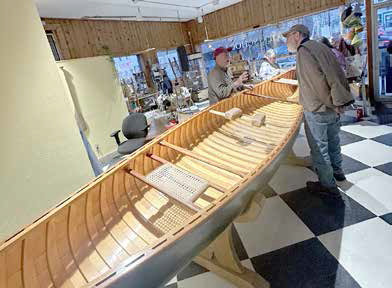
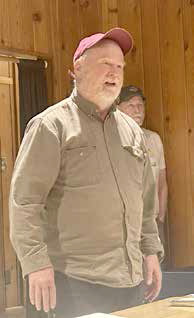
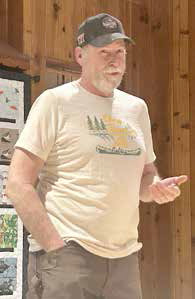
Tom Grant, the current canoe master at Camp Widjiwagen, brought the very last canoe that Joe Seliga and his wife Nora made together for the film’s audience to see up close. The canoe itself is absolutely priceless, as the work of an Ely living legend. One audience member who prefers to remain anonymous, is the lucky owner of one such Seliga canoe. They generously offered their contact information and company if anyone is interested in going for a canoe ride in a genuine Seliga: give them a call at 608-279-6455.