
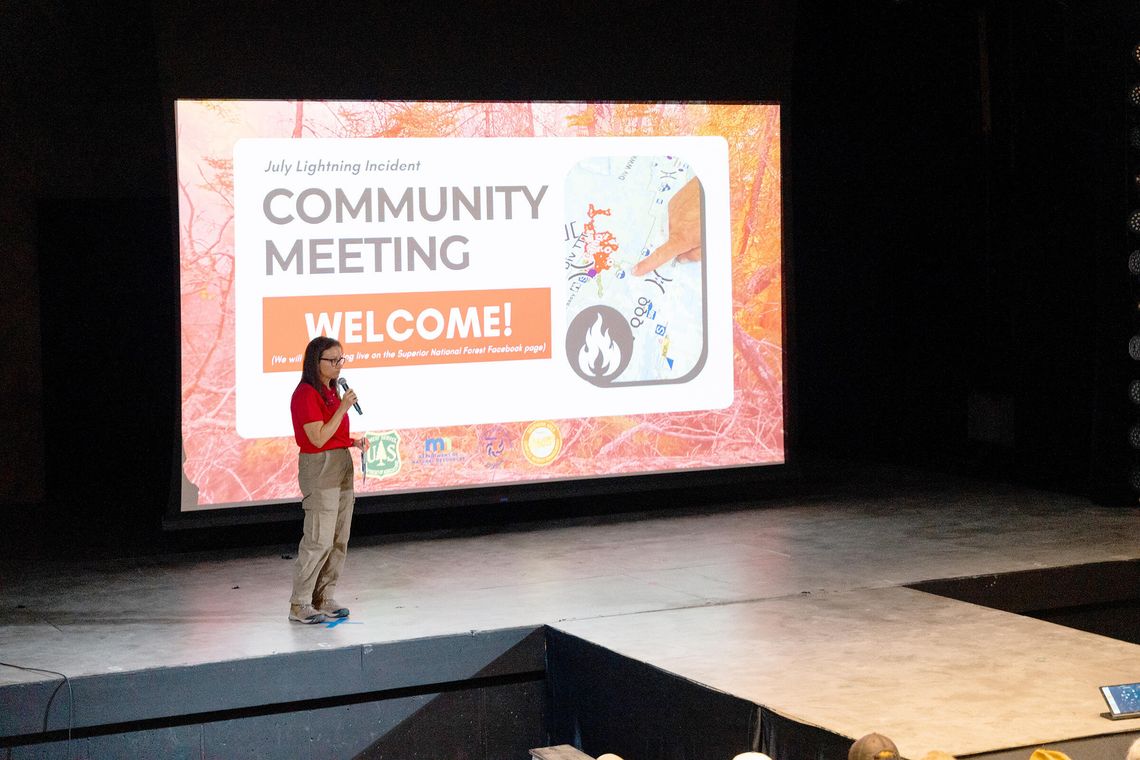
Nearly 1,000 people attended a public information meeting on wildfires last Sunday evening at the Minnesota North - Vermilion campus, both in-person and virtually.
Chamber of Commerce president Tanner Spicer told the crowd that he reached out to state legislators in wake of the Blueberry / Arts Festival cancellation to seek economic relief for local businesses.
“This is when Ely makes its money and how we get through the winter,” Spicer said. “These fires are unprecedented, and the ripple effects of this are not going to be felt just now. This is going to carry on for the rest of the year and beyond.”
Spicer said legislators have been receptive, and talks are underway about working with the IRRRB and the Minnesota Department of Employment and Economic Development for aid.
“This is not something that’s going to wait forever, but (we need) to start on these things right away, because businesses can’t wait that long,” Spicer said.
Spicer said the Chamber made the difficult decision to cancel the festival given the strain an influx of 30,000 - 40,000 people would inflict upon emergency resources already stretched thin with wildfire work.
“To bring in that many more people would have been terrible,” Spicer said.
Spicer encourages visitors and locals to continue patronizing Ely’s local businesses.
“Everybody always says shop local, but oftentimes that doesn’t happen,” Spicer said. “Now is the time to stop talking and actually start doing.”
The Southern Area Complex Incident Management Team has now taken over command of several key fires in the region.
Operations Section Chief Shane Sturgill provided updates on fire response coordination.
The Bear Trap Fire has stayed to the north of the Echo Trail. Aviation resources have focused on eliminating heat signatures along the fire’s perimeter.
Sturgill says the perimeter work buys firefighters time to establish lines and hold the fire in place. The priority on this fire is to prevent its passage across the Echo Trail to the south, where key infrastructure and structures are in place, including the Big Lake Lodge and the Lodge of Whispering Pines.
The Camp Fire has also seen heat signature extinguishment strategies along its edges. The protection of the Winton Hydro Station and structures along the Fernberg Trail represent the key priorities in this area.
Firefighting personnel on the Sioux Fire have also concentrated their efforts south of the Echo Trail through the establishment of handlines, followed by water attack and aviation resources.
Fuels along the Echo Trail corridor have been addressed to create defensible firefighting holding advantages, Sturgill said. Teams have established contingency lines in the area.
The Thumb Fire has seen work along its northeast perimeter, but remains a difficult-to-reach wilderness burn.
The western series of fires, including the Echo 2, Marion and Chub, have seen active suppression activities every day and are now on patrol status. This means firefighting teams go in daily and handle any heat signatures they detect.
“They’re very small in nature, but they’re still in the landscape. They’re still a threat and we want to make sure all the heat is gone out of those footprints of that fire,” Sturgill said.
Firefighting teams continue to prioritize structure protection and infrastructure.
Sturgill says the team moves methodically through the woods near fire footprints to search for structures and establish defensible space around the properties through vegetation removal and other means.
“It’s kind of an Easter egg hunt. We go out, we look for structures and we’re finding a lot of those structures we didn’t know were there,” Sturgill said.
National Weather Service incident meteorologist Kari Fleegel provides firefighters with hyperlocal weather information as needed, including wave height on particular lakes for canoe teams or data for specific locations.
Fleegel said the Ely area received just 50-70% of normal precipitation totals in the two months leading up to the lightning fires.
Combined with several record high temperatures across the Arrowhead, fuels dried quickly — and Fleegel said the region still hasn’t reached its peak heating season yet, which occurs around early- to mid-August.
“There’s more fire season ahead of you than there is behind you,” said Art Gonzalez, fire behavior analyst for the Southern Area Complex Incident Management Team.
Gonzalez said the Ely area has not seen this level of drying by mid-July in at least 20 years.
The Arrowhead region has simultaneously seen the worst spruce budworm outbreak since 1961 in recent years, contributing over 1.3 million acres of dead spruce and balsam firs to the fire-ready fuel load.
Many of the fires have exhibited spotting behavior, with hot embers jumping ahead and pulling the flames far beyond fire footprints.
“It is mind blowing to see how this fire was island-hopping. It would burn over a half mile to a mile of water, land in available fuels, burn those fuels, get up and go to the next island,” Gonzalez said. “It’s incredible.”
Gonzalez said the fires have burned up to three feet into the ground in some locations.
“It’s not a normal fire season. It’s going to be here for a while, folks,” said incident commander Kyle Smith. “I hate to say that, but we’re just getting into it.”