Northspan’s community and economic development work will continue across northeastern Minnesota, with the Moving Forward Together project soon to launch into action.
Project analysts narrowed in on housing and next-generation leadership development as the top areas of need for northern communities, followed by development of local information-sharing systems.
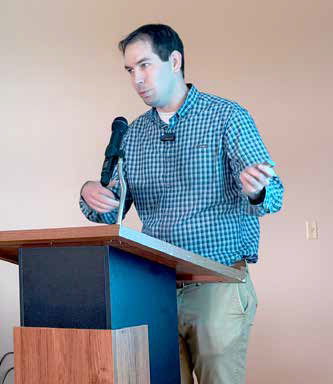
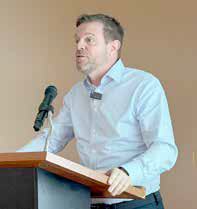
Northspan vice president Karl Schuettler provided an overview of the Moving Forward Together initiative at a Tuesday Group presentation earlier this week.
The initiative aims to address unfilled gaps in community needs across the Arrowhead region. It is a collaborative effort between Northspan, a Duluth-based community and economic development consulting nonprofit, and the Northland Foundation.
Northland Foundation president Tony Sertich said the project aims to provide suggestions, not answers, to regional municipalities.
“There is no single answer, and we’re not coming with answers,” Sertich said. “We’ve merely done the research, we’ve engaged our communities, and based on their suggestions, there’s a plan and there are some ideas. But it’s going to take all of us in our different roles to really engage in this.”
Research commenced in 2024 to identify needs among the five tribal nations and seven counties contained within Northspan’s service area.
Northspan representatives led two rounds of community engagement, sourcing public opinion from 250 participants across eight focus sessions in fall 2025, followed by eight follow-up sessions involving over 300 participants in spring 2026.
Community members provided feedback on the region’s challenges and ideas for action steps.
Project representatives ultimately chose seven challenges to focus on across the Arrowhead, adding four tertiary action areas to the top three: increasing residents’ sense of belonging, encouraging dialogue on divisive topics, increasing the efficiency of regional planning systems and developing a rural-tribal alliance.
“While there are many other challenges, these topics emerge as serious issues on which we can still genuinely move the needle,” Northspan stated on its website.
Northern Minnesota’s shifting demographics have increasingly posed a challenge for housing availability, the top issue identified by Northspan’s analysis.
Though birth rates have declined across the Arrowhead, the region’s population has remained relatively stable, largely due to an influx of migrants from other areas in the state — especially retirees.
Northeastern Minnesota has increasingly favored older age brackets. The population over age 65 has grown 36% in recent years, while the population under age 18 has declined by 15.5% since 2000.
The average household size has shrunk, with smaller families and larger numbers of older couples occupying a greater number of housing units. These trends have coupled with the Arrowhead’s comparatively high proportion of second homes and short-term rental units to exacerbate housing shortages.
Schuettler said the topic arose in every single community meeting Northspan held in its first round of public opinion research.
“It’s something that really came out strongly as something we need as a region,” Schuettler said.
“We need to set goals around the number of units and just get it done, instead of trying to solve a bunch of different issues at once,” Schuettler said.
Sertich said state formulas used to distribute financial assistance to housing projects often favor large metropolitan developments, rather than smaller-scale projects in outstate areas.
“The first question on every housing application that cities sign up for is, ‘How many units are you going to build?’ That completely puts rural communities in the back seat because it’s based on the number of units,” Sertich said.
Sertich recommends a model that factors in the percentage of a city’s population that could be serviced by a new development.
With a lower density of contractors than metro areas, counties in northern Minnesota must come together to share, attract and create regional developers by establishing a larger framework of community projects, Sertich said.
“That takes us all getting in the same room and laying (things out) and saying, you might go first on this one but we’re going to go second,” Sertich said. “They’re developing a bigger plan.”
The regionalism that Northspan and the Northland Foundation advocate for applies to other challenges as well, Sertich said.
“It’s going to take all of us working together in different ways,” Sertich said. “We need to tackle things as a region because we are rural, and this is the big part about this framework: no single community should be expected to solve all of these challenges on our own.”