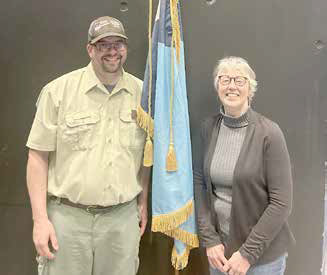
Last Thursday, the Forest Service held an educational talk about “Wildfire resilience, firewise, and best practices learned from homes lost in recent wildfires.”
Gloria Erickson, Firewise coordinator for St Louis County, and Jeb Backe, USFS fire management officer, facilitated the discussion.
Firewise and wildfire resilience are terms used to describe lowering a community’s overall risk to a wildfire event. Around 90% of wildfires are caused by humans, and in certain weather conditions, it’s not if a wildfire will occur, but when.
One of the easiest actions a household can take is to ensure their driveway and access are accessible by Emergency Services.
Vegetation should be cleared around road markers, four feet above the road surface, and a driveway should be cleared of limbs and brush up to 14 feet high to accommodate a fire truck or ambulance.
“Can a crew chief send it down your driveway? Fire trucks need a turnaround at least 30 feet in radius or a hammerhead turnaround 60 feet across,” said Erickson.
Weather and terrain are both out of human control, but types of fuels are within a community’s control to cut down on damage should a fire start.
Even if there is no open flame near a house, the vacuums created by ductwork, ventilation, and siding can suck smoldering embers into attics and onto flammable surfaces.
Backe recommends installing gable vents of two pieces of overlapping 1/8inch mesh, which will help prevent embers from entering the house.
The most important zone is the area zero to five feet around a house, also known as the “defensible zone.”
Homeowners should take extra care with this area around every structure on a property. It is recommended to remove all flammable plants and replace with succulents, or any plant that has a high moisture content.
Firewood and propane tanks should be at least 10 feet away from structures, while dead vegetation and pine needles should not be allowed to accumulate on the lawn or around objects. Replace wood mulch with a non-combustible landscaping agent and trim low-hanging trees.
The number one reason that houses burn down is open decks and foundations.
“We love our decks and our porches, that’s why we live here! But, it’s a nice dry place under there, and I bet some people store their wood, old construction projects, gasoline cans…if you have a tall porch, you can clean it out and keep it clean,” said Erickson.
“If you have a short porch, how many times do you wanna crawl underneath there and clean? So what I’m asking you to do is crawl under there, clean it out of everything, and then enclose it in an 1/8 inch or less metal mesh. Three reasons: You never wanna go under there and clean it again, you wanna stop critters from going in there and building nice, dry nests…and the mesh will hopefully break up the embers.”
According to Backe, spring in Minnesota tends to be peak fire season.
“Just because of the amount of cured fuel out there.”
In years without normal precipitation and proliferation of moisture, summer dries the area back out.
Dependent on weather, it comes down to what Ely can do as a community to increase Firewise practices.
“We all love the forest, it’s our livelihood, we don’t want it to burn down…number one concern is protecting people,” said Erickson.