Fish Pictures
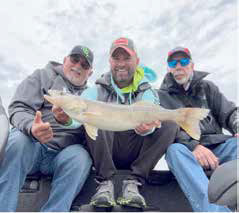
T his picture was taken on Leech Lake with Calm Outdoors pro Matt Johnson and my friend Bob. Matt got us situated, set his focal length, leaned the phone on the step up, pushed the timer button and sat between us for the picture. All done in less than 20 seconds. Obviously, Matt has done this picture before, but it does say something to the rest of us about planning and preparation to take a fish picture.
So exciting to catch photo worthy fish that you would like to get a shot for bragging rights or just a cool picture of yourpartner.Iaskmypartnerstophoto whenIcatchaphotoworthyfishandget a big variety of results.
First objective is that our fish survives in great condition by given the best care possible during the whole photo event.
Rule #1: Do not let fish be out the water any longer than you can hold your own breath.
Rule #2: Do not drop fish onto the floor.
Rule #3: Do not set fish on the floor and let it flop around.
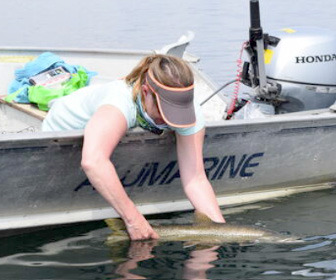
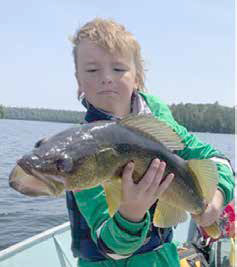
Rule #4: Do not squeeze the fish belly or eye balls, handle with care. Tail hold in the meaty area away from fish organs is okay as demonstrated by my grandson, Kellan Banovetz.
Rule #5: Handle fish with wet hands so not to remove protective slime.
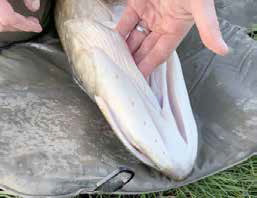
Rule 6: Learn how to slide hand under gill plate without damaging the gills.
Rule #7: Have fish ruler and camera ready before pulling fish out of the net.
Rule #8: Rapala pro staff Brad Jurrarie demonstrated how photos, measuring, and releasing those big fish can be done within 30 seconds.
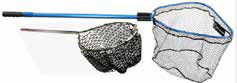
Taking care of big photo fish starts atthenet.Thereareseveralnetdesigns thatarelessharmfultofishlikesilicone and rubber coated nets with no knots. Old style nylon nets with knots rub off the protective slim.
I use a deep 30” knotless rubber coated net for big fish and a silicone shallow net for panfish.
I do not lift fish into the boat and will remove the hook while the fish is still in the net in the water when ever possible. Sometimes I need to lift a fish out of the water and have to set on the floor, but try to get control as quickly as possible so the fish does not damage its internal organs flopping around. I set the net edge on the next seat so the fish does not touch the floor while I pick it out of the net when ever possible. Fish that are not photographed, and I’m not keeping, never see the inside if my boat. Unhookinthenetandletthemswimoff.
L earn how to unhook fish in the net while the fish is in the water and never have a slimy northern trashing your boat again! Get some longer plies!
The next step is proper handling of the fish. For walleye, bass, northern, trout,andmusky,themostusedmethod of holding and controlling the fish is to slide two or three fingers under the gill plate and move forwards to front of the mouth, into the v shape in the jaw. Don’t worry, your fingers are not near the teeth and are perfectly safe. Then useyourthumbtoputpressureonyour forefinger for gripping.
This is known as the chin grip. This gives you complete control of the fish and keeps your hands and fingers away from any teeth. For northerns you should be mindful of the gill rakers, these are rough spines which cover the gills and can nick the skin on the back of your fingers if the fish flares up and thrashes. It doesn’t hurt but is enough to occasionally draw blood. If you do feel that the fish is about to thrash, having a good grip is vital in order to prevent the fish from hurting itself and you. It’s also worth trying to gauge where your hooks are before sticking your hand in blind, the last thing you want is to chin a fish and get a hook stuck in your finger.
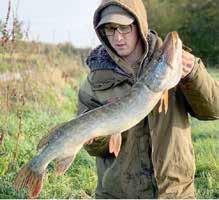
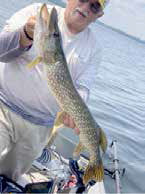
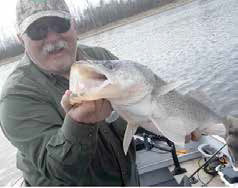
Onceyouhavecontrolofthefish, the next step is to support the fish body like Matt Johnson did in the first picture and the guy holding the northern and you will be ready for the photo of your life!!
Don’t be fumbling around looking for your cell phone or camera while the fish is out of the water getting dried out by the sun! Iuse my cell phone for most pictures and always ready and easy to access immediately. Leave the fish in the net in the water until the photographer is completely ready including phone on and picture mode ready. Lift the fish out of the net and get into your pose quickly. With a little practice you can do two or three poses. Have the cameraoperatortakeabunchofphotos for each pose so you might get one or two good ones.
Get the fish back in the water quickly but do not just toss the fish in the water, let it go with care and respect for old marble eyes or that bronze back warrior.
If you had a big battle getting the fish in the net, the fish will build up lactic acid in the muscle like we do when we get cramps. I have worked over the side of the boat with fish for 45 minutes so they can swim away.
If a fish just sinks when you let it go, it will just lay on the bottom and die. If you pull up a fish from too deep, then the fish will suffer barotrauma: Rapid changes in water pressure can prevent gas release. Some try to plunge the fish back into the water but it never works. Don’tfishdeeperthanabout30to35feet unless you plan to keep the fish. There is a technique called fizzing that can be used,buttheDNRdoesnotrecommend doing this. Lake trout is the only fish able to release air from the bladder as it is raised from deep water.
O ne o f the things to consider i s doing some boat maneuvering to get the sun behind the camera operator. Use the water line or horizon to get a level picture. Don’t cut off the head and only take a picture of the fish.
Try different focal lengths for close ups or full pictures.
Practice with your cell phone or camera in the boat before catching the photo fish.
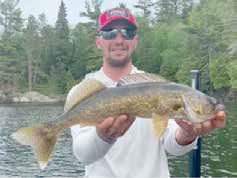
Learn to keep your fingers out of the picture. Curl your fingers to support the fish body or just use finger tips like my friend,BASSClassicchampandKenora guide, Jeff Gustifson. Jeff recommends extending your arms some, but not too far, to improve your fish picture.
Please practice catch and release to preserve and protect the spawners and trophy fish.
Get outside and take a kid fishing!