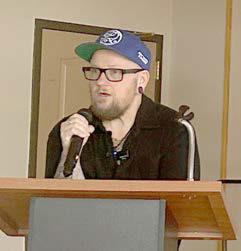
Tuesday’s Boundary Waters Connect speaker was Awen Briem, a local master tattooist and custom tattoo artist. Briem educated the group on the history of tattooing and how tattoos of today have been informed by over 7,000 years of known tattoo traditions from across the globe.
Briem began with the oldest confirmed example of tattooing available: Ötzi the Iceman.
Ötzi was discovered in 1991 by hikers in the Swiss Alps. He is so well preserved, authorities initially thought he was the victim of a recent crime.
However, upon further examination his true age of over 6,500 years old was revealed. Ötzi has 61 tattoos on his body, mostly hidden by clothing on his legs, back, and chest. They aren’t particularly decorative, consisting of mostly tally marks and the occasional cross symbol.
According to the Smithsonian, the tattoos were placed on the body over pre-existing evidence of scars and previous injury. This suggests that the tattoos were attempting to use meridians, used in today’s acupuncture therapy, to soothe chronic pain caused by old injuries.
Another famous example of ancient tattoos exists with the 2,500 year old Siberian Ice Maiden. It is assumed she was of significant status to the Pazryk people of Althai, as she was buried with two warriors and six horses in a radial pattern.
Her most notable tattoo is of an animal with a griffin’s beak and deer antlers adorned with flowers. The tattoo was likely applied using ink made from soot and bone needles.
The two warriors buried with her were also heavily tattooed, with hybrid-style animals covering their arms. Given her tomb’s extravagant offerings, she was a very important person, and her tattoos would have added to her status rather than detracted from it.
Tattoos have a long history as a social status indicator amongst Indigenous peoples, and they have been used as rites of passage for physical and emotional healing, protection, and identity.
Tattoos became fashionable for Western civilization in the 19th century, when members of the British royal family were tattooed in their travels to Jerusalem and Japan. By the 1900s, tattoos traveled to the U.S. “by way of the sailor.”
Classic American traditional styles such as nautical stars, hearts with a loved one’s names inscribed within, and sailing ships were popularized amongst maritime workers, but the tradition of “earning” a tattoo still persisted. Only sailors who had crossed the equator were allowed the coveted shellback turtle tattoo, and sailors could get a swallow tattoo for every 5,000 nautical miles traveled.
Unfortunately, tattoos have also been weaponized through colonization as a way to identify those who do not belong.
The Māori of New Zealand are well known for the practice of ta moko, or facial tattooing; their severed heads became collector’s items among European colonizers as a result.
During the Holocaust, victims were famously tattooed with a serial number, for reasons that still remain unknown according to the Auschwitz Memorial.
The practice succeeded in further dehumanizing prisoners and making them easier to identify, should they escape from the concentration camps. These practices of tattooing prisoners, criminals, and enslaved folks gave way to the negative stigma around tattoos that still persist today, and are rooted in harmful stereotypes.
Despite a bad rap, tattoo artists serve very real needs within their communities.
First and foremost, tattoos allow freedom of self-expression and free speech for everyone, and reclaim bodily autonomy from traumatic circumstances.
They can reconstruct breasts for breast cancer survivors, cover scars from surgery, self-harm, or traumatic events, and can provide medical alerts for allergies and medication.
During Covid, many tattoo studios were unable to remain open, and donated their personal protective equipment to nearby hospitals, of which one audience member at Tuesday Group was actually a grateful recipient. Briem also has used his tattoo business as a fundraising platform, for those with overwhelming medical bills. It’s not everyday a master tattooist takes up residence in a small town; Briem is open for tattoo appointments now on his website: artwithapoint. com. He specializes in custom pieces, rather than walk-ins, and loves to have a conversation with a client about their design idea.
Everyone is always invited to BWC’s Tuesday Group from 11:45-1:15 p.m. on Tuesdays at the Grand Ely Lodge. Next week’s speaker is Hannah Maia, producer of the film Wood on Water.