Just over one week ago, on March 20, the vernal equinox occurred, marking the sun being directly over the Earth’s equator. Considered as the first day of spring, observances and reports now fall within the period between winter and the summer solstice in June. For the person who photographed a woolly bear caterpillar near Ely and another who sighted American robins in Virginia, MN this week, they could record them as Spring firsts for those places.
Everything exists with a flow of changes over time. Some changes are more rapid than others. Seeing, hearing, and touching all provide means for measuring, recording, and reporting aspects of the world around us. At this time of year, water continues to change and impacts daily life. Evaporating, freezing, thawing, melting, flowing, rising, falling, heating, cooling, and moistening are just some of the ways H2O engages with everything on Earth and in its atmosphere.
Just following the weather reports and events as winter transitions through spring will provide continuous updates on the places and conditions changing through the transitioning temperature and water. Next week, on April 1, a fourth and fifthgrade age group will participate after school in an Ely Community Resource field trip to the Shagawa River. This outing will sample the water and life associated with it.
People living here observe, discuss, and report on daily passings over the Shagawa River. They know about the water flowing from the Rainy River Headwaters of the North St. Louis County Soil and Water Conservation District. Shagawa River flow comes from Slim Lake, Crab Lake, Wolf Lake, Burgo Lake, Twin Lakes, Burntside Lake, Longstorff Creek, Armstrong Creek, Shagawa Lake, City of Ely, and Morris Township. That flow continues on through Winton to Fall Lake.
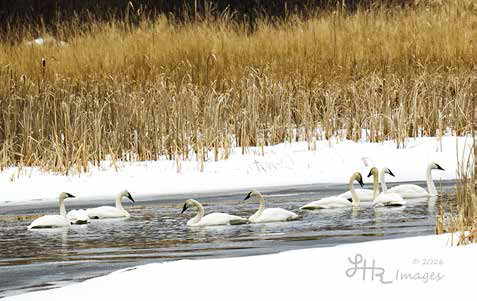
With all of the flow through Shagawa River it may have open water off and on throughout the winter and then usually opens like this year before the spring equinox. Therefore, oxygenation from rapids and sunlight from open water enable plant and invertebrate life to provide food for fish and waterfowl. Common goldeneyes may be seen at times when water is open in winter and in recent years, the returning trumpeter swans from wintering areas in southern Minnesota find this a late winter location until shallow water lake areas have open water.
The swan arrival makes this stretch, and sometimes on toward Fall Lake, one of the best observation areas for waterfowl in spring breeding plumage. Some species, like trumpeter swans, are already paired, and others are displaying courting and pair-bonding activities involving competition before mating and nesting.
T he presence of trumpeter swans encourages observation and photography of day-to-day behavior for memories and as a professional artist’s pursuit, like photos recently taken and displayed by Larry Ricker. The presence of swans encourages curiosity and learning about the life of the river, the plants and animals living there, and the flow of water and the seasons.
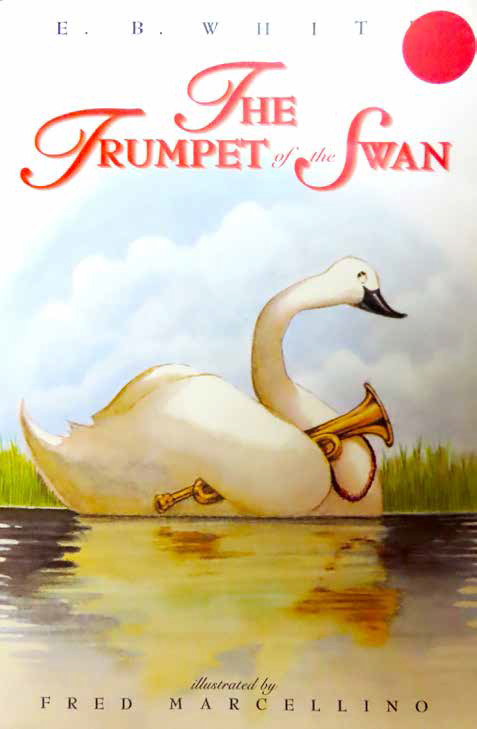
Trumpeter swans were nearly hunted to extinction during the fur-trade era, through hunting and the sale of their skins for marketing feathers. By the late 1800’s, what had been their widespread range across North America was reduced to a few remote locations. One of those, near Yellowstone National Park, was Red Rock Lakes National Wildlife Refuge, which became the location of a fictional book written by E.B White. The main character, Louis in The Trumpet of the Swan, was a swan connected to a family from that area. It was a popular chapter book read to elementary students in Ely during the early 2000’s at this time of year when swans first started to reappear on the Vermilion Range and appear on the Shagawa River in the spring. A book that enables people of this area to understand the difference between Trumpeter Swans and Tundra Swans and the life cycle of Trumpeter Swans is The Trumpeter Swan: A White Perfection. That book’s text and photography by Skylar Hansen contains a brief history and understanding of the swans we are observing today on the Shagawa River.
Just seeing trumpeter swans, like the five flying over Sheridan Street in Ely this week, provides so much pleasure. In addition, an opportunity then exists when curiosity and questions arise about what is happening behind that experience. There is a story there, and you, plus the children that learn the story, can share plus add to it, and the woolly bear, robins, and even the first deer ticks of spring seen this week.