
Go to main contentsGo to main menu
Saturday, April 11, 2026 at 8:20 AM

Chapter 11 – World War II

Chapter 11 – World War II

The world never really “settled down” after The Great War. Germany was reeling after severe sanctions and reparations were thrust upon it by the Allies and the Treaty of Versailles. The Roaring Twenties brought a false sense that a short-lived boom would last forever. Then came the ’29 Crash and the entire world was affected by the Depression. Unrest and hard times led to the rise of charismatic leaders who espoused policies that, while temporarily popular, couldn’t be sustained. Unfortunately, they gained enough support to establish militaristic autocracies under the politics of fascism in Italy and Germany and Communism in Russia. On the other side of the world, Japan went on a campaign of conquering land in Southeast Asia, China, and Korea. Being an island nation of limited resources, they needed oil and minerals from the mainland to sustain themselves and their ambitions going forward. These had consequences for the United States and, in turn, the Finnish community.

Stalin in Russia was suspect of many of his own population. His purges in the 1930s executed hundreds of thousands and many more thousands were sentenced to the gulags. Needing manpower to replace those eliminated, Russia came to the U.S. to entice Finns to repatriate to the Karelian region to what they advertised as a “utopian society”. They were moderately successful, and several families moved back to the Russian-controlled part of “the old country”. What they found was much different from what they were led to believe. Stalin didn’t trust these new immigrants and most of the men were assigned to hard labor camps or sent to the gulag. There is a book written by Mayme Sevander called “They Took My Father.” Her family had emigrated back, and her father disappeared soon after. Later in life she came back to this side of the ocean and lived in Duluth. She told a sad and compelling story. My dad related stories of classmates who one day weren’t in school and later found out their families had moved back to Karelia, never to be heard from again.

In 1939, Germany and Russia signed a non-aggression pact, and on Sept. 1, they jointly invaded Poland, starting World War II. Emboldened by their success, Russia invaded Finland in December, hoping to regain what used to be a duchy under their control. It was called the Winter War. Finland was greatly outmatched militarily. Russia, however, was not prepared for what it encountered. After purging many of his competent generals, those who were left had dubious credentials and no battle experience. They made blunder after blunder and the Finns developed battle tactics that took full advantage of their mistakes. A severe winter caused the Russians further problems as their machinery broke down and many times wouldn’t start. Clothing and rations were inadequate for cold and snow. Eventually, even with poor battle tactics, sheer numbers turned the tide. Russia found they had no stomach to continue to take the kind of losses they were taking and sued for peace. Though the Finns kept their sovereignty, Russia acquired about ten percent of Finnish territory.
Though the allies sympathized with Finland, Russia, by treaty, was their ally, and so they didn’t become involved.

(Continued on Page 13) Many volunteers did go to Finland, however, to fight with the Finns. Soldiers from many European countries and America went to fight. Many of those were first- and second-generation Finns who had emigrated or were born soon after their parents arrived. After Germany started Operation Barbarossa and turned on Russia and invaded that country, the Finns allied with Germany and tried to take back some of the land they had lost in the Winter War. This was called the “Continuation War.” After some early success, they were eventually driven back and had to give back what was originally ceded to Russia. Joining the war on the side of Germany had repercussions throughout the rest of World War II and after its end.

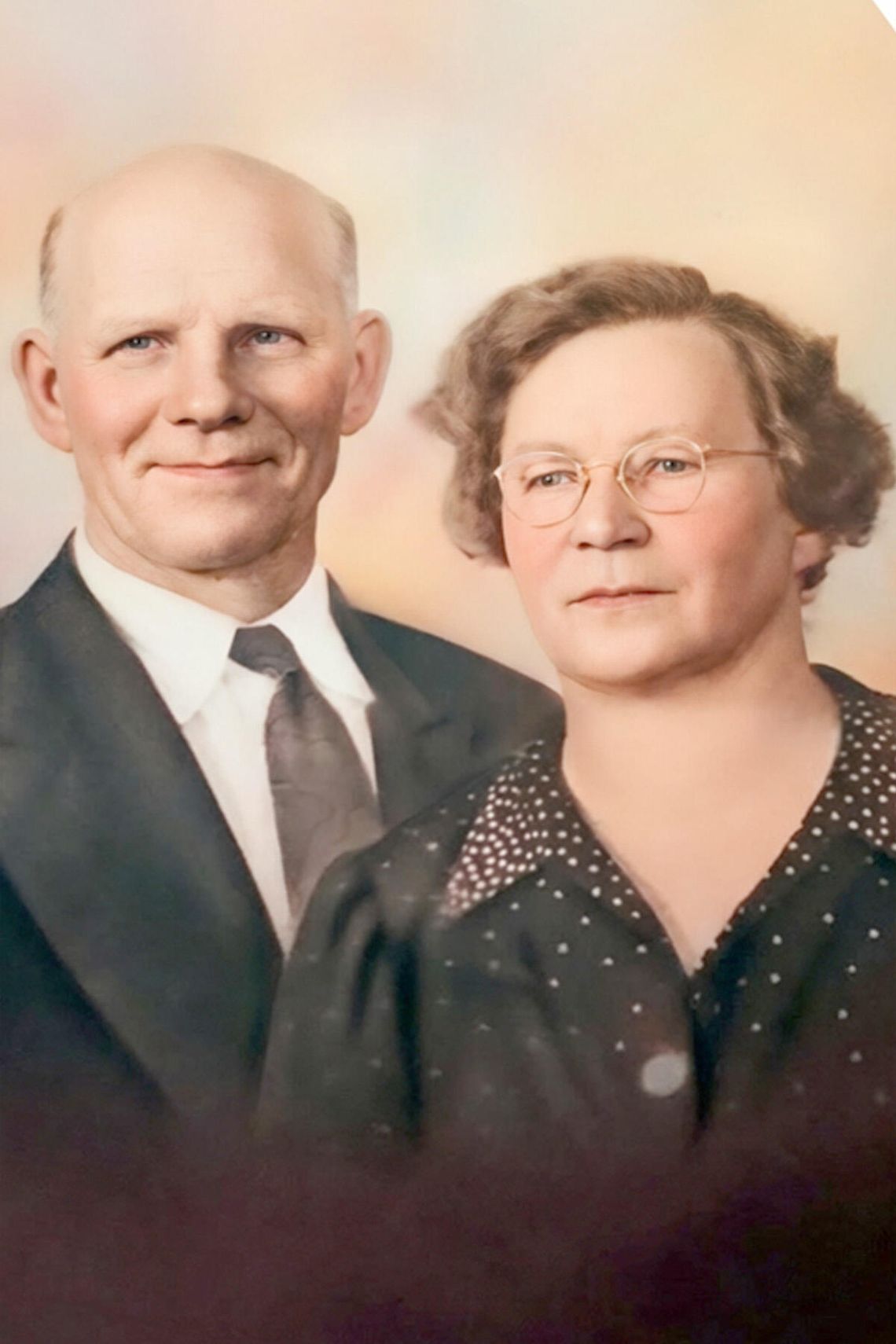
Edwin and Helmi in the late 1940s
Alvar draft registration.
Kinnunens - Helmi, Uncle Bill, Ida, Otto and Nellie
Edwin draft registration.
E. Kiriluk drawing one
High School - Rey Kannas left, Alvar right
E. Kiriluk drawing two

When the U.S. entered the war in 1941, many of the young men in Balsam either enlisted or were drafted. Though my dad was drafted and tried to enlist numerous times, he couldn’t pass a physical and did not enter the military. After graduation in 1942, he worked in the mines, went to college, and spent time at Rajala’s lumber camp.

WW2 held other experiences for my Grandpa Edwin. He was an avowed pacifist and had left Finland to not be involved in the Finnish Civil War. When the war found him in America, he had a real dilemma. Though not a U.S. citizen – remaining an alien – he was still eligible for the draft into the military. Indeed, there were instances of that happening with others. My friend Bob P. from Bovey told me about his dad’s experiences. Paulie P. had fought in the Winter War and was wounded in hand-to-hand fighting the Russians. After that conflict ended, he came to the United States and was here just over a year before he was drafted and sent to France to fight for the U.S. He was also wounded there and became one of the few who fought on both sides of the war and became a casualty of each side.

By the time America had entered the war, Finland had allied with the Axis Powers and Edwin was concerned that if he went back, he could be fighting against his close relatives. He chose instead to go into hiding. He spent about 18 months in a little cabin on Greenwood Lake with a Russian ex-patriot of similar concerns. The Russian’s name was E. Kiriluk and he was an artist. He gave my grandpa some pencil drawings before they parted ways. My dad would tell stories of the FBI coming to the farm and asking if “you’ve seen your dad recently.” How hard they looked might be debated. There was nothing said by the authorities when he came home or after the war. The only time he seemed concerned was in 1970 when he considered a trip back to Finland because a sister had passed and he was summoned because of her will. At the last minute, he decided not to go because he was afraid the U.S. wouldn’t let him back into the country.

As to Finland, they survived the war with their sovereignty. Russia had done a lot of damage that needed attention and the Allies demanded reparations from all in the Axis alliance. Finland was the only country on that side of the war that completely paid all reparations. Because so many men were lost in the war, Finland returned to America to try to persuade former emigrants to return home. Since then, it has been a steady, forward-looking country.

After the war, life went on. The farm started to get smaller and fewer animals were kept. The resort was providing an income and they had few bills. My dad and his sister Aili – who was still in high school - lived at home. All that would soon change.

Next time: The Third Generation


Share
Rate

Ely Echo
Babbitt Weekly