There was a time in Ely when boys became men far too quickly.
They grew up during the Depression, worked hard from the time they were young, and when their country called, they went. They did not ask for recognition. Most rarely talked about what they saw overseas. They simply came home, went back to work, raised families, and quietly carried both pride and pain for the rest of their lives.
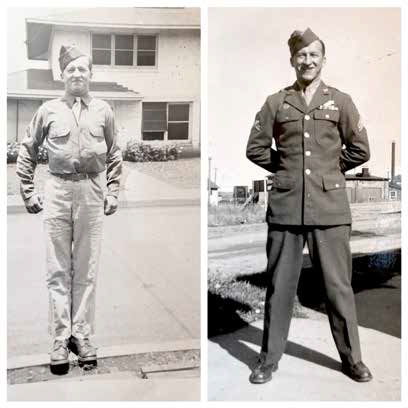
Frank Louis “Totsy” Mavetz was one of those men.
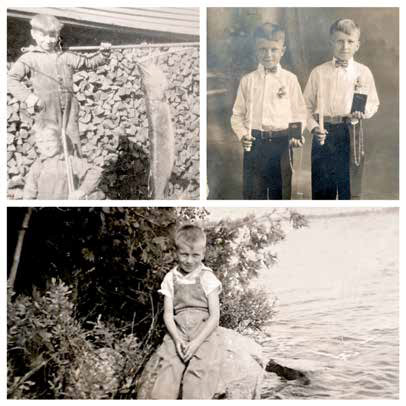
Born in Ely on Jan. 12, 1920, Frank entered the world at a time when the iron mining town was filled with immigrant families building new lives in northern Minnesota. His parents, Josef and Frances Mavetz, were part of that strong generation that believed in faith, family, sacrifice, and hard work. Those values would shape Frank for the rest of his life.
Early on in his life, he was nicknamed, “Totsy” and no one could remember or ever knew how he got that moniker. My father, John Mavetz, was about two years younger than “Totsy” and told me once he thought the name came from his brother being smaller in stature as a toddler – at little “tot.” Whatever the origin, the name stayed with him throughout his entire life. Only during his years in the army, he was known simply by his given name, Frank.
There were 12 siblings in the Mavetz family. Frank was number 10 in the family birth order.
When World War II erupted, Frank answered the call to serve in the United States Army. Like so many young men from Ely, he left behind the familiar woods, lakes, and streets of home and entered a world most of us today can hardly imagine.
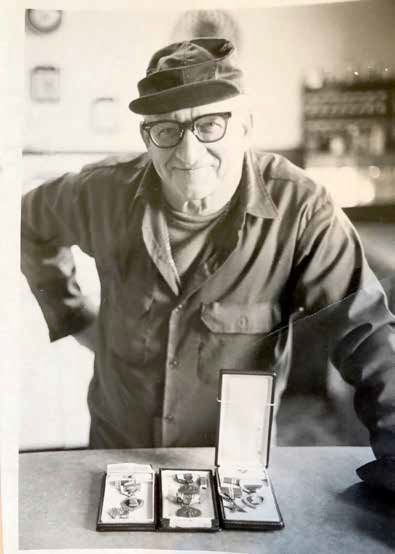
The medals he earned tell a story few words can fully explain.
Frank received the Bronze Star, awarded for heroic or meritorious service in combat. He also received the Purple Heart with Oak Leaf Cluster, meaning he was wounded not once, but twice in battle. His service included the Asiatic-Pacific Campaign Service Medal, the Philippine Liberation Medal, and the World War II Victory Medal — reminders that the war reached far beyond Europe and into brutal fighting across the Pacific.
Yet for many veterans of Frank’s generation, the medals were never the most important part.
Coming home was. After the war, men like Totsy returned to Ely and resumed ordinary lives that were, in truth, extraordinary. They became neighbors, workers, husbands, fathers, parish members, and volunteers. They carried memories they often kept to themselves. Many never spoke about the battles, the fear, the friends they lost, or the injuries they endured.
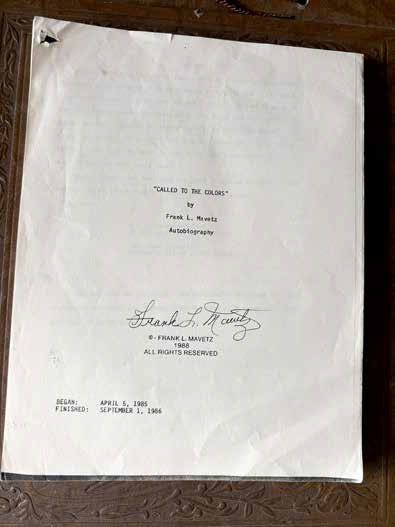
Instead, they simply lived. Forty-one years after returning home, on April 5, 1985, Totsy started the process that took 16 months to document, as best as he could recall, what he had seen, endured, and lived through during his time as an enlisted soldier in the United States Army.
This memoir came about after family members and friends urged him to document his experiences during World War II. I dug out my copy of this autobiography that my uncle wrote to memorialize his military service.
I sat down on Sunday evening and began to read the book aloud for both my benefit and my boyfriend, who is a Desert Storm and Desert Shield Army veteran. It was a fast read and I finished it the next evening. I had read it more than 35 years ago, but back then I do not think I fully absorbed the incredible nature of his story.
During his time in the Philippines, Frank encountered jungle insects (he was bit by two large centipedes at the same time), snakes, contaminated water, monsoon rains, dysentery, malnutrition and poor sanitation. Diseases were rampant. Soldiers battled malaria, scrub typhus, dengue fever, beriberi, typhoid fever, cholera, jungle rot, tuberculosis, elephantiasis, gangrene, skin and fungal infections. Many soldiers feared disease almost as much as enemy fire. In the Philippines, the jungle itself became an enemy.
Frank also found himself standing just a few feet away from General Douglas MacArthur on a beach in the Philippines. In his memoir, he wrote: “They called him “Doug out Doug” but this much I have to say about him, I couldn’t help but admire him: he was all soldier every bit of him. Could see he was a “West Pointer,” the way he walked and carried himself. Seems as if he had that drawing power and just fascinated a guy. While he was walking up and down the beach, air raid sirens sounded and, of course, cameramen were taking pictures of him. This air raid must have been planned as there wasn’t an airplane within 300 miles of where we stood. Old Mac, he sure was putting on the “bluff,” course most of the guys fell for it.”
The realities of war often depended upon rank. Frank wrote bitterly about the contrast between the food and living conditions of officers versus the men fighting on the front lines:
“Didn’t take (Doug out Doug) MacArthur long to build his palace on the hill. You wouldn’t even think there was a war on. Rumors were that he ate fresh lettuce from the “States,” and here men were starving and dying. Just how could a person like a guy like that. He had about 250 M.P.’s watching his rear end and as I’ve mentioned before he had the people back home buffaloed about the dangers, etc., he was in. What a bluff. He couldn’t carry water for Walter Kruger, Lt. General of the Sixth Army.”
Combat itself was chaotic and unforgiving. Frank saw terrible accidents involving equipment and grenades. Some soldiers accidentally triggered firing pins, killing themselves and others nearby. Friendly fire also claimed lives. As casualties mounted, experienced soldiers became scarce. At one point, Frank’s unit had dwindled from 175 to just 38. Replacement troops – often young and inexperienced “green” recruits -- were sent in to fill the ranks. Many lacked combat experience, and for far too many of them, death came quickly.
Many American soldiers, if captured alive by the Japanese, were tortured and their bodies mutilated beyond recognition. One common method used to ensure a soldier was dead was repeated bayoneting far beyond what was necessary.
The human mind could also begin to betray exhausted soldiers. Fear, stress, lack of sleep, disease, and constant danger sometimes caused men to fire at imagined figures in the jungle. Hallucinations not only endangered the individual soldier, but entire units.
Frank often served on patrol – an exhausting responsibility and a critical part of defending their position. He once remarked that he would rather stay awake protecting others than sleep and become a sitting duck himself. Sleep was another commodity that was often in short supply.
Humanity was always at the front of Frank’s mind. Enemy or not, he suffered when he would see dead Japanese soldiers even though it is in the front of a soldier’s mind to “kill or be killed.” He had watched an entire building housing 22 Japanese soldiers set on fire. You could hear the Japs scream as they were burned to death. Frank wrote, “Really a pitiful sight to see, even if they were Japs.”
Totsy always had a tender heart. He was one of the most giving people I can ever remember knowing in my life. He based his life on giving – of himself, his possessions, and his money. I remember on winter days he would wake up in the wee hours of the morning and shovel out neighbors, siblings and friend’s sidewalks and driveways. His goal was always to make people’s lives easier – maybe with a surprise for the recipient that they did not have to go out in the cold to shovel the white stuff.
He was my godfather and chosen by my parents because of who he was. He would make what he called, “The Rounds,” at least once a week visiting his brothers and sisters in Ely and Winton. He enjoyed a good cup of coffee and no matter the time of day, would almost never turn down a cup. He loved homemade wine and often would have a batch fermenting in his basement.
Totsy always drove a truck. We lived about three blocks from the Ely Dairy Queen, and it was a big deal to go with him in his truck. We did not climb into the cab – we got to ride in the box! These excursions most always included a drive through town while we excitedly licked our small vanilla ice cream cone or push-up novelty courtesy of Uncle Totsy. There were no car seats to be fretted about and riding in the back of a truck was a common occurrence in Ely.
While reading his memoir, I saw the same soft-hearted Totsy I had always known. He wrote of how he felt for his comrades and when their lives were lost, he lamented over their families back home. He faced death at its doorstep – both personally and over his brothers in arms. He lived through Hell on earth as he watched the bodies of his war buddies blown apart and the smell of death surrounding him too many times to count.
The foreword of this book reads: “Having discussed the war at times, with my friends and relatives; I’ve been asked to write of my experiences in a world conflict of which I had participated. After much thought, I finally decided to write or should I say, make a few notes of my life as an American soldier in World War II. Some of the happenings will be clear and some will be vague as almost 40 years have gone by since the war’s ending. Still, this is a challenge in many ways, and I’m going to give it a try. After all, what can I lose?
Lest I forget, two men, whom I’m proud to mention in honor to them who fell as we fought together, this book is dedicated.
They are: P.F.C. Joeph Mikolich Killed in action on May 8, 1945 P.F.C. John Pecharich Killed in action on May 9, 1945 May they and men and women, who have died in World War II, (and all wars) for their own causes, rest in peace….in peace and glory, not only of World War II, but of all wars.”
I took a deep breath, sat down on the couch, and began reading. Here is an excerpt from the first page and a half of this book that filled 90 pages, double-spaced and hand typed by one of his nieces. The original book he had written out in his beautiful penmanship on wideruled notebook paper with a blue ball point pen. I remember seeing it in process in his living room on his desk. At that time, he was nearly 500 pages into the process.
“CALLED TO THE COLORS” by Frank L. Mavetz Autobiography “The Day Of Infamy.” I remember that day clearly. Roosevelt made that speech on Monday, December 8th 1941 on the radio. I was sitting on the radiator in the tavern listening to what happened at “Pearl Harbor.” A thought came to me out of nowhere that I would end up as an American soldier; get badly wounded; and that I would survive the war. How true this all became. Also, World War II really came home and affected all of us. Besides myself, I had two brothers who served. John had to go winding up in the 617 Clearing Company and seeing plenty of action in Germany. Louis, the youngest, went too; going into the M.P.’s and then into the Engineers and also leaving for the Pacific ending up on Luzon in a combat zone still infested with Japanese. Joe, the oldest of us, couldn’t make it due to an eye injury that he received years ago. How sincere he was to go like the three of us. I knew how he felt being rejected. Two bro-in laws went too. Tauno Maki became a Lieutenant in the Eighth Air Force in England, having many missions over Europe under his belt. He was to be shot down, helped by villagers and return home. Jim Bungert was assigned to the Infantry (Mounted) seeing much action in Germany. He was awarded a silver star. So, as one can see, World War II reached deeply into our family.
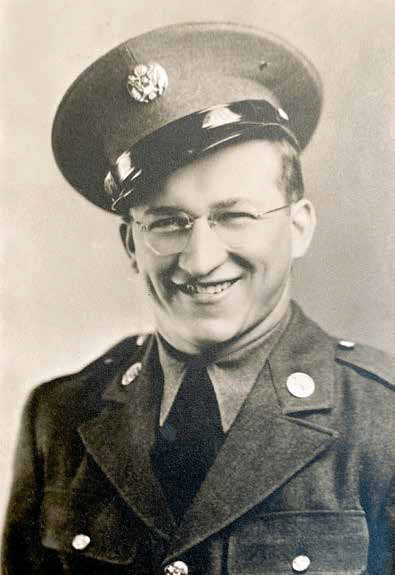
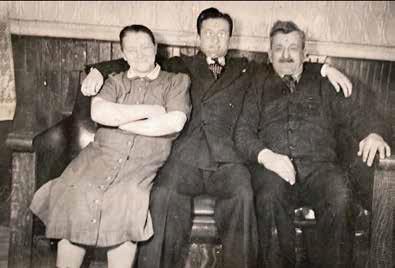
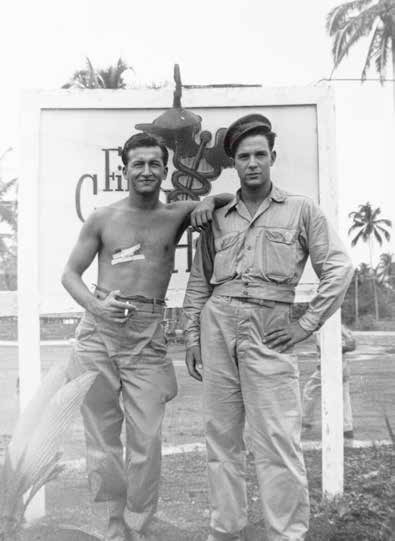

I was inducted into the Army on February 2, 1942. On saying, goodbye to my father and mother, (shaking hands with my father and kissing ma goodbye) all this taking place in the living room; never thinking that I wouldn’t see either of them for almost forty-five months. Our group having been denied a furlough because of the Midway Battle shaping up. Troops were needed in Oahu, Hawaii as soon as possible fearing an invasion of the “Islands.”
Embarcation was at the Ely city hall where my brothers and sisters saw me off. My group consisted of the following that I remember: Joe Mikolich K.I.A., John Pecharich K.I.A., Arne Wirta K.I.A., Vick Tolyon, Frank “Popo” Rozman, Ed Hoppa Joe, Fritz Christopher, Tony Zupec, John Bobence, Bruno Kauppi, and Vince Hren. Remembering the others fails me.
All this seemed like a dream; war declared in December and here in February. I was being a part of it. How quickly uncle Sam gave me my greetings. My Selective Service No. was 772. No time was being wasted on their part (Gov’t).
Sister Angela (Mikolich) whom was lost in later years (Jan., 1957), had us over for a big steak dinner. Joe (Yosh), “Popo” Rozman and I. How wonderful for us three to be together before leaving. “Yosh” had a premonition that he wasn’t coming back and was going to be killed. What a thought. I remember how he cried. Who would ever think that that “thought” was to become true.
Going back a day or so before I left home. I had saved some money while working for the City of Ely. Ma needed false teeth, so I left her $80.00 of my savings for her new teeth. In later years I learned she just never got them. Had an extra 27 bucks which I took with me.
Another thing I had forgotten to mention was a party that was held in our honor upstairs of the U & I Bar. At that time, it was located at Central and Sheridan. This was for the Slovenian boys being inducted. Plenty of accordion music and everyone had a good time.”
************
This was the beginning of chronicles that would span almost 45 months. Horrific, life-changing memories filled the 90 pages of Totsy’s book. Several times, I found myself stopping to wipe away tears and take a deep breath before continuing.
Here is the last page and a half on his return to his beloved Ely. I have typed it in exactly as it appears in his book.
“Came into town on Ely passenger (train) and who should be waiting at the station, none else but sister Margaret (Ikey). My did she look thin and frail, Jim must have gotten home just ahead of me. Was wonderful to shake hands with my Father as also a big hug went with it. Course those hugs were also given, as were kisses to Angela, Rose, Pep and Fran. Brother Joe too, was greeted in the same way. Well I was home, finally home. My time from leaving Ely Feb 2, 1942 to Nov. 14, 1945, came to 3 years, 8 months and 29 days. When I think about all this now it really seems like one big dream. Wore my uniform a couple of days and then took it off, kind of felt pretty darn good to get back in my civilian clothes again. My feelings: I did the best that I could in fighting for my country, for God, for America’s freedom and ideals and especially I felt proud that I’d had done my duty for our family, as we were of Slovenian decent.
I had two visits to make. I had to do this for Joe Mikolich and John Pecharich. It was the least I could do for them as they were buried on Mindanao of the Philippines. I went to see Mr. Mikolich first with my brother Joe, really glad to have him with me, I talked to Mr. Mikolich about Joe and of course, with tears in his eyes, he took Joe’s death with a very heavy heart. And as for me; it was tough on me too, what can you tell and what can you say in situations such as this. My eyes weren’t dry either. And then too, Joe and I went to see the Pecharich’s for Johnnie, this situation was so much harder still, not only for me but for John’s parents. His Dad took it pretty good too with tears in his eyes, but for John’s mother, we both cried and she kept asking me why I didn’t bring Johnnie back with me, this wasn’t only so tough and hard on her, but I too was badly hurt inside. How could I ever forget moments like that, I think about this a great deal, as I too, could be laying in the same cemetery in that Tolomo River Valley with just a number on my cross indicating just who I am.
Both John and Joe are now buried in Ely, having been moved from Tolomo No. 1 to Tolomo No. 2 and finally resting in peace here in our cemetery. And as I had mentioned at the beginning of this manuscript, I am mentioning it again now, that it is in their honor that this book is written. May they and so many others, who have died fighting for a cause, rest in peace and in glory of God, I close my book this day, September 1, 1986.”
**************
The war never left Totsy. He suffered recurring bouts of malaria that would leave him extremely ill, and there were periods of time when we simply would not see him. Shrapnel remained lodged in his chest, causing excruciating pain throughout his life. In those days, there was little understanding of what returning soldiers carried home emotionally. There was no diagnosis of PTSD –- only the vague and often dismissed “shell shock” to explain their emotional and mental struggles.
Like many veterans of his generation, some of the war followed him home. I know there were times when the weight of it all became almost too much to bear, but his Catholic faith would never allow him to give up on life. Totsy cried often and would speak of the many buddies who never returned home from the war. He especially grieved for the Ely men mentioned above. He never forgot them.
Totsy stayed a bachelor until he was 66 years old, when he reconnected with an Ely girl he had known in his youth. Rose Marie Kozar Scott, a widow living in Ohio, came across an article about him in the Ely Echo and contacted him. The two quickly struck up a courtship and were married in Ely in September 1987. They were married until Rose’s death on June 12, 1998.
Totsy remained rooted in the place where his story began — Ely. When he passed away on April 19, 2001, at the age of 81, he was laid to rest in the Ely Cemetery, among generations of others who helped shape this town. I am particularly grateful he passed gently in his sleep, spared from a painful death after all he had already endured.
It is Memorial Day weekend. Perhaps take a walk through the Ely Cemetery and read the names etched into the stones. Many belong to young boys who once walked these same streets before finding themselves on distant battlefields across the world. Their stories are woven into the history of this community whether we realize it or not.
Sometimes we forget how much courage once quietly lived next door.
Frank Mavetz reminds us -- not through speeches or headlines, but through a life of service, sacrifice, endurance, and hometown loyalty that defined an entire generation of Ely men and women.
And perhaps that is the greatest tribute of all.