
Go to main contentsGo to main menu
Saturday, July 4, 2026 at 9:48 AM

Hooked on Fishing: Weed Walleyes

Hooked on Fishing: Weed Walleyes


Theweed-walleyeconnectioniswell documented, and many walleye tournaments have been won by targeting walleyes above, outside, and buried in weeds. Species of aquatic vegetation used by walleyes vary with environments. Seasons develop certain species of vegetation as walleye sanctuaries while others are shunned. What weeds do walleyes use most, or in what order as the environment changes with the seasons?

Work vegetation from the outside edge inward, don’t pile right into the vegetation. Start well outside the weed line and feel for the edge and what kind of plants are present by jigging. Initial casts don’t even reach the weed edge because that’s where the big fish are andcastingintothem,theygetspooked.

Most days, the type of vegetation is important and once you contact fish, stay with the same vegetation that day. Mid-summer cabbage lines and coontail clumps stop between six and 20 feet, depending on water clarity. In our area, we have some very clear water lakes and many that have tannin.

The presence of tannin in water is most common in low-lying or swampy areas and heavily forested regions. Tannin is often responsible for giving water a tea-like appearance, yellow or brown tint, and slightly bitter taste. Because some lakes have more tannin than others, weed growth depth varies, but can say for a lot of our lakes a weed line of about 10 feet is a common depth for the two common species. My home lake weed line is only ~six feet.

It takes time for the complex food chain that starts shallow and minnows don’t inhabit those deep edges until the plants mature. When those plants get too thick, walleyes will avoid weed beds that are overly dense. Walleyes like new growth in a stair-step progression, using plants at four to six feet, then within a few weeks they move down to those at eight to 10 feet, and so on. The deepest are coontail and sandgrass down to about 20 feet. That’s where they stay until ice-up.

Fresh Water Hall of Fame, Greg Bohn says, “Wind pushes walleyes shallower, but I love to fish vegetation on flat, sunny, calm days right after a cold front. Bluebird days after fronts can be awesome in weeds. Walleyes favor shade and hold where feeding is easy. Look for fish activity on the surface. Young perch dimple the surface and outline a weedbed in calm water. Watchforthemskippingoutofthewater, indicating predators on their tail. But windydaysaregreat,too.Ineithercase, I catch walleyes in weeds with 1/16- to 1/8-ounce perch-colored jigs.”

As surface temps warm between 60°F and 68°F switch from minnows to leeches, then to crawlers under slip bobbers from 68°F and up. When plant growth is developing, panfish become a nuisance, especially at the leech-andcrawler stage. Soft baits take off when the water reaches 60°F and will outproduce live bait in warm water.

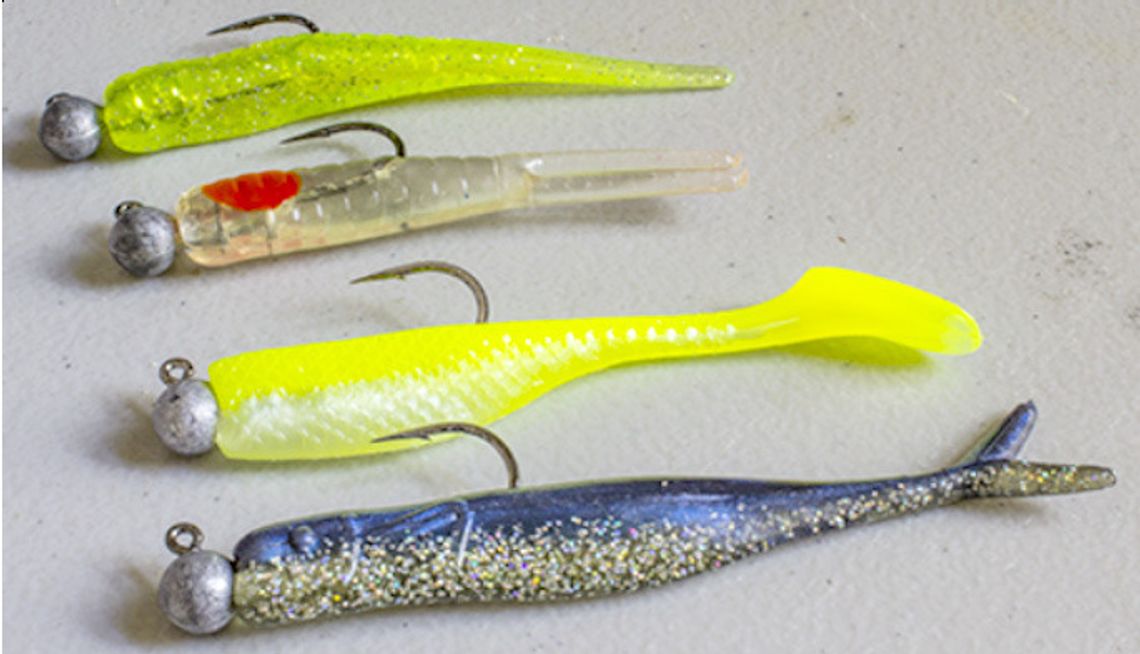
Using 10# mono with plastics is preferred over braid because thicker diameter mono will have an arc to the line as the jig drops where as braid cuts through the water with a faster drop. Mono floats which aides in the action desired. Walleyes tend to hit on the drop, so having that arc, slight pause at the top, and slower fall trigger more strikes than fast dropping braid. Also on the lift, the stretch in mono creates amore natural movement than braid which will be more abrupt. No need for long casts, either. In weeds, short casts are a must.

When fishing soft baits, you need to be theonecreatingaction that will require something a little different from day to day. Some day it might be pop up and drop or move horizonal before dropping. Incorporate a pull, a short swim, or slow lift to give walleyes a chance to locate the jig. I move my rod between 10 o’clock to about 12 o’clock and will slight pause at 11 o’clock to feel for light bites.

Threading soft plastic baits on jigs must be done perfectly to prevent spinning, circling, or running sideways as these will not produce. Make sure the bait looks symmetrical and straight, notoffbalance,bunchedup,orcrooked. Withminnow-shapedsoftbaits,domore twitching. With action-tails, twitch less and swim more. Hopping them is good, but aslow, steady swim can be best. With soft baits, you want to set the hook immediately. If you feel a tip or a tap like a perch tapping a nightcrawler, that’s a strike. Alot of strikes are weight strikes, if you feel weight, set the hook!

Pro Tip: If the plastic bait slips down the jig hook, use a small dab of super glue to paste the plastic to the jig head. Buy the multipack of smaller tubes.

Slip bobbers are hard to beat for weed fishing. An interesting evolution in slip bobbers happened with the advent of forward-facing sonar with aero dynamic slip bobbers and specially designedsharpshooterrodsforcasting slip bobber rigs.

Pro Tip: Use a rod with bigger eyes and not one with micro eyes to lessen the slip knot from banging into the eyes affecting your distance and accuracy.

Iliketousespinnerstoskimtheweed tops. Ashorter 12” leader, larger spinner blade, and lighter 1/8 bullet sinker and hook tipped with a Berkley Flat Nose minnow, or fluke tail retrieved with the rod tip high. Play with reel speed to keep the spinner from dropping into the weeds. Shorter casts are easier to manage.

Anaggressivemethodisusinglipless type lures ripped through the weeds.

Walleyes will key on the bait ripping free from weeds. Casting to weed gaps and weed edges lessen snagging weeds, but if you do, just give the rod a good swift jerk to break the lipless lure free from the weeds. This is a reaction bait method to add variety to your techniques.

Don’t let those ‘damn weeds’ frustrate you, concur your fears and adventure into a new fishing experience.

Get out and take a kid fishing!


Share
Rate

Babbitt Weekly