
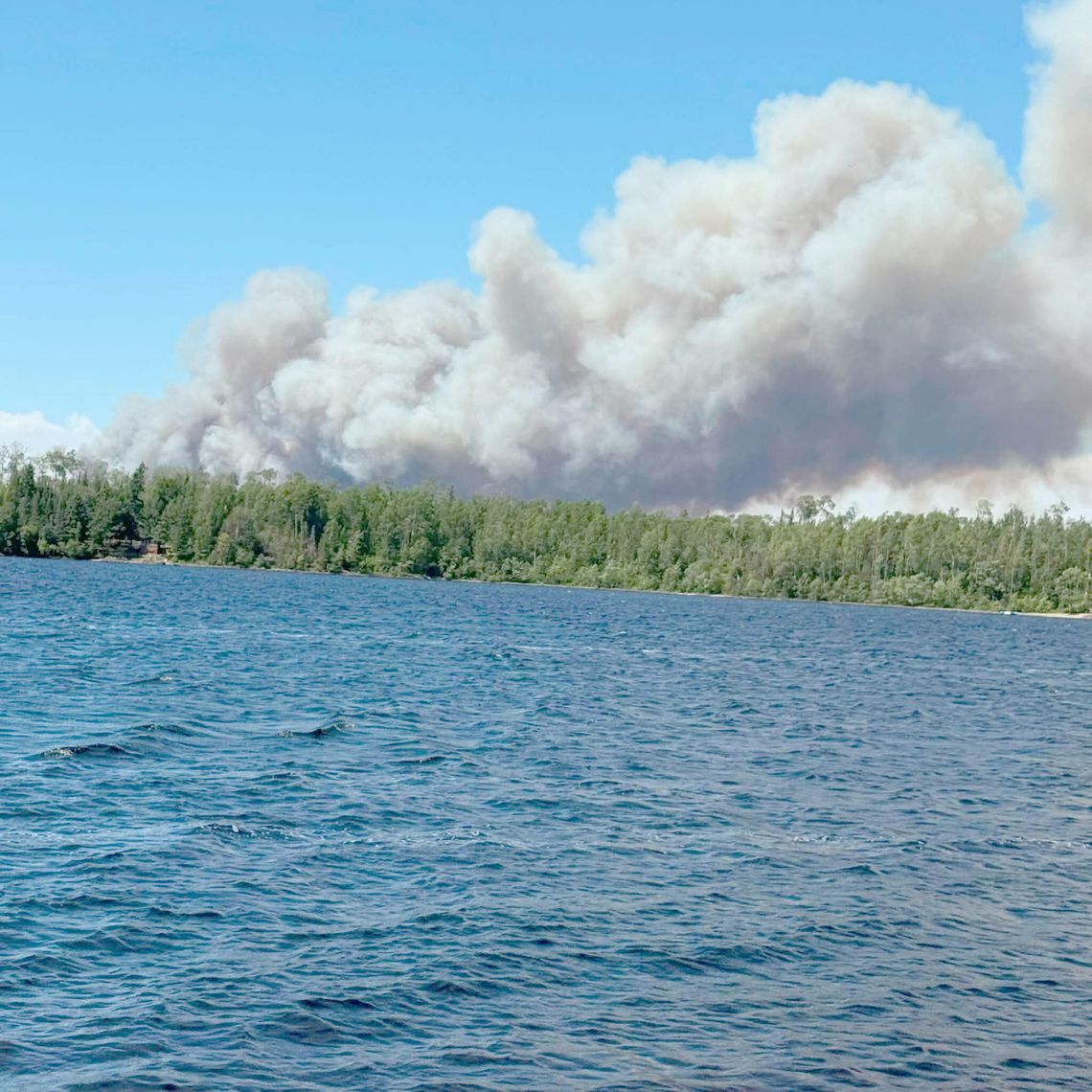
Amid ongoing fires, increasing fire danger and excessive heat, the Boundary Waters Canoe Area Wilderness has been closed.
The closure order takes effect at 12:01 a.m. Tuesday and comes as temperatures soared into the high 90s and numerous fires burned in the wilderness area.
The fires have also prompted some evacuation orders near the Cloquet Line area, with St. Louis County implementing its “Ready, Set, Go” notification system.
During a briefing Monday afternoon, U.S. Forest Service officials said public safety prompted the decisions.
“Looking at the forecast, which called for more red flag conditions today and the potential for more dry thunderstorms with lighting and continued dry weather, we made the difficult decision, the very difficult decision to close the Boundary Waters for the time being,” said Drew Stroberg, acting Forest Supervisor for the U.S. Forests Service.
Stroberg said the decision was made late Sunday and outfitters and permit holders were subsequently notified early Monday “so that way we didn’t have folks going out this morning only to be turned around.”
Refunds have been issued to permit holders and it’s currently unclear when the wilderness will be reopened.
“We do not know how long this closure will be in effect,” said Stroberg. “Our intent is to keep it as short as possible. “Our goal is for people to have a reasonably safe experience in the Boundary Waters and protect the safety of the firefighters and the general public and right now and we don’t feel we can do that.”
Teams of two Forest Service personnel were dispatched into the wilderness, traveling via canoe to various campsites to notify travelers of the closure and order their evacuation.
The full closure comes after portions of the wilderness were closed earlier as fires grew and conditions worsened.
“Our plan at the time was to manage through this with restrictions in place but with the recent fire activity, especially yesterday with the red flag conditions, and we had a couple of fires that had significant growth.”
Nick Petrack, a Forest Fire Management Officer for the Forest Service, said that the area has been under dry conditions for more than a week with no relief in sight.
“We have seen some rapid fire growth in the last couple of days with high temperatures and winds,” he said.
Petrack added that the agency is keeping its eye on a “cluster of fires,” some within the wilderness and some just outside.
He described the Thumb fire as having grown to 5,000 acres, the Bear Trap to 3,000 and the Dark to 600 acres, and reiterated the efforts to protect public safety as well as that of firefighters.
“We’re looking at where we can put our firefighters safely,” said Petrack.
Fire conditions across the country are also stretching Forest Service resources, although Petrack said crews from Arizona and New Mexico are among those headed to northeastern Minnesota.
About 70 firefighters and 50 support staff are currently on the ground, although that number is expected to increase.
Suppression efforts include aerial attacks, which also played a role in the decision to close the wilderness.
With Beaver and float planes being used to help fight fires, Stroberg said “if we need to divert those planes to search and rescue, you’re taking away a critical resource to fight the fire, and if we have a search and rescue in there, you’re putting rescuers and other Forest Service employees in an area that’s potentially dangerous.”
A Red Flag warning is in effect until 10 p.m. Monday, while a fire weather watch is in effect through Tuesday evening, along with a heat advisory as temperatures were expected to climb to 100 Monday and into the 90s on Tuesday.
“We need the weather to cooperate in our favor until we can throw some people in there,” said Petrack.
Petrack said some fires may not be completely put out until the arrival of snow in late-fall, and that some areas of the wilderness may be closed “for the duration of the season.”
“We fully recognize this has a major impact on communities and on people’s livelihoods,” said Stroberg. “We intend to keep this as short as possible.”
Cook, Lake and northern St. Louis counties all have burning restrictions in place until further notice. Campfires are not allowed in backcountry, dispersed or remote campsites on state-managed, public or local lands.