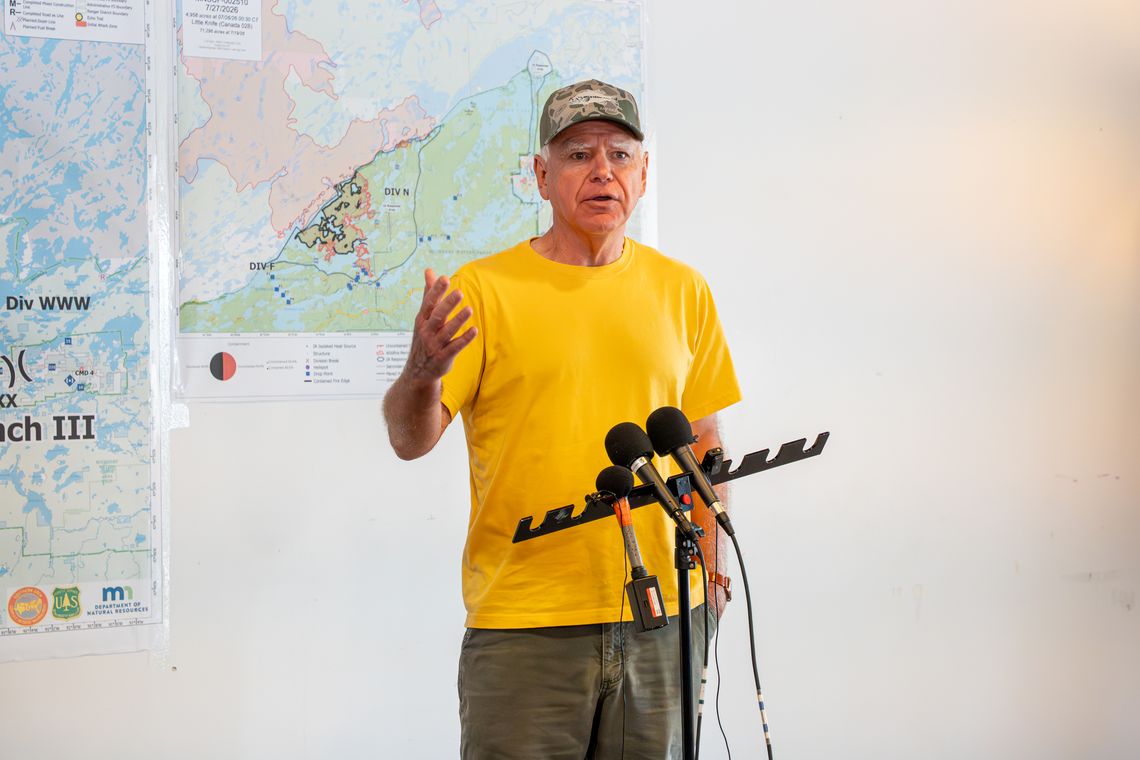
Governor Tim Walz signed an executive order to protect Minnesota’s the Boundary Water Canoe Area Wilderness (BWCAW) from nonferrous mineral mining.
He is expected to be in Ely today following a speech in Afton at 10 a.m.
The governor’s order directs the Minnesota Department of Natural Resources (DNR) and the Minnesota Pollution Control Agency (MPCA) to stop all permitting and environmental review work on nonferrous mineral mining projects in the Rainy River Headwaters Watershed (RRHW).
This order also directs DNR to not issue any new leases or permits for nonferrous mineral mining projects in the RRHW and to immediately review all existing nonferrous mineral leases in the RRHW to ensure that the BWCAW is protected for generations to come.
“The Boundary Waters is a national treasure and home to some of Minnesota’s most pristine waters and wilderness,” said Walz. “This place is deeply personal to me, to Minnesotans, and to people across the country who have paddled these waters. I am using my full executive authority to protect the waters and wildlife of the Boundary Waters and to ensure the outfitters, small businesses, and communities that depend on it continue to thrive for generations to come. It’s our duty as Minnesotans to ensure the sacred place remains wild, pristine, and unharmed.”
This action follows Congress’s vote to overturn a 20-year federal shield against mining in the BWCAW, opening the door to renewed nonferrous mineral mining proposals, including copper and nickel. Those proposals threaten the region’s wilderness, water, and nearly $1 billion outdoor recreation economy.
Under Executive Order 26-10, the DNR will:
• Together with MPCA, halt all new environmental review and permitting work on proposals for nonferrous mineral mining in the RRHW until the Northeastern Minnesotans for Wilderness v. DNR litigation is fully resolved.
• Decline to participate as a cooperating agency in any federal environmental review of a proposed nonferrous mineral mining project in the RRHW.
• Offer no new state nonferrous mineral leases or surface leases for nonferrous mining operations in the watershed.
• Review every existing state nonferrous mineral lease within the RRHW and strictly enforce compliance with lease terms.
• Draft legislative language to permanently prohibit nonferrous mineral mining in the RRHW for consideration in the agency’s budget and policy proposals.
DFL State Sen. Grant Hauschild slammed the governor's move.
"I strongly disagree with Governor Walz’s decision to ban non-ferrous mining in the Rainy River Watershed. A decision this significant to the people of the Northland should not be made through executive order by a Governor who leaves office in a matter of months. My constituents are tired of executive overreach by politicians who no longer feel accountable to the voters or the legislative process, whether that’s in St. Paul or in Washington.
"The truth is, no one can honestly say whether they support a mining project before it has gone through the full environmental review and permitting process. Minnesota has some of the strongest environmental and labor standards in the country. If a project can’t meet them, it shouldn’t move forward. I also don’t believe politicians should pick winners and losers or decide the answer before the science and the process have had their say. Northern Minnesota deserves both a strong economy and clean water. Those values do not have to be in conflict. Most importantly, the people who live in our region deserve a meaningful voice in decisions that directly affect our communities, our environment and our economic future," said Hauschild.
Republican State 3A Rep. Roger Skraba said, "Today’s decision by a lame-duck governor with one foot out the door is a devastating blow to the Iron Range and the entire Northland,” said Skraba. “Minnesota already has some of the strongest environmental protections and toughest permitting standards in the world. Instead of letting that process work, Gov. Walz is putting his thumb on the scale and shutting the door on responsible mining here at home. All that does is send these jobs and critical mineral production somewhere else, including countries with weaker environmental standards, weaker labor protections, and in some cases, countries that are openly hostile to the United States.
“Politicians in St. Paul shouldn’t be picking winners and losers or deciding the outcome before the process is finished. Northlanders are tired of having our future decided for us by leaders who don’t understand our communities, our people, or our way of life. Let the review process work, let our communities have a voice, and let the chips fall where they may.”
Republican Congressman Pete Stauber (MN-08) made the following statement after Walz issued a blow to critical mineral mining in Northeast Minnesota.
“In the twilight of his failed Administration, it is disappointing, yet unsurprising to learn that Governor Walz has launched a spiteful and harmful attack against the hardworking people of the Iron Range. His radical, job killing executive order puts thousands of family-supporting union jobs at risk and ignores the will of those who actually live and work in Northern Minnesota. In addition, it jeopardizes the crucial school funding that benefits every district across the state. Next time a Democrat politician claims to support permitting reform, remember what they really mean: eliminating the process altogether, just as Governor Walz has now done. Years of rigorous review, environmental study, and massive private investment have been erased in seconds by a deeply unpopular Governor, who has once again shown that he places far-left ideology above Minnesotans’ jobs and economic future.
“Simply put, the Governor’s executive order is an outright war on Northern Minnesota and our way of life. I encourage every member of the press to reach out to Senator Amy Klobuchar to see where she stands on this issue. The Iron Range, and every Minnesotan, is watching at this critical moment, and they deserve a clear answer,” said Stauber.
Julie Lucas of MiningMinnesota issued the following statement:
"Governor Walz's executive order is a political decision dressed up as an environmental one, and Minnesotans deserve to know the difference. The governor's own Department of Natural Resources concluded a six-year legal review that considered more than 4,000 public comments and the most current science available, and ruled definitively that Minnesota's nonferrous mining regulations are strong enough to protect the Boundary Waters and its watershed. With this action today, the governor is bowing to the demands of special interests, ignoring the findings of his own government and causing even greater delays for workers who need jobs, to the detriment of the Minnesotans he serves. Even though the order itself lacks legal standing and precedence, the negative impact on Minnesotans remains the same.”
“The Boundary Waters Canoe Area Wilderness is a Minnesota treasure, and we have a responsibility as Minnesotans to ensure its long-term protection,” DNR commissioner Sarah Strommen said. “Today’s executive order and the work that follows strengthen those protections.”
“The significant advancements to protect human health and the environment by reducing greenhouse gas emissions, increasing the amount of recycling, composting and diversion from landfills, and creating climate-change-resilient communities in the last eight years create a safer, more sustainable state for future generations,” said Katrina Kessler, commissioner of the Minnesota Pollution Control Agency. “At a time when the federal government is stepping back on its commitment to protecting the environment and the people who live here, the state of Minnesota under governor Walz’s leadership is stepping up.”
“The science is clear: copper mining and the Boundary Waters cannot safely coexist. This action helps safeguard the clean water, world-class wilderness, and outdoor economy that generations of Minnesotans cherish,” said Becky Rom, Save the Boundary Waters national chair. “The Boundary Waters is simply too important to gamble with, and Governor Walz’s executive order is a major step toward ensuring this irreplaceable wilderness remains protected for future generations.”
This action is part of nearly eight years of work to protect Minnesota’s environment, advance clean energy, and preserve the state’s lands and tribal regions. During the Walz-Flanagan administration, greenhouse gas emissions have fallen by more than 16 percent, 60,000 clean energy jobs have been created, and sustainable aviation fuel innovation has advanced through nation-leading tax credits. The administration has also banned PFAS “forever chemicals,” made Minnesota a leader in EV adoption, saved state agencies more than $100 million in energy costs, and helped drive nearly a 20 percent increase in visits to the state’s nationally ranked parks.