Governor Tim Walz signed an executive order on Tuesday morning banning all nonferrous mineral mining within the Rainy River Headwaters Watershed.
The order prevents the DNR from issuing new leases and permits for all noniron mineral extraction within the watershed and requires the agency to review existing leases for this type of mining in the defined area.
The DNR has issued 38 total nonferrous mineral leases within the Rainy River Headwaters watershed.
The governor’s ban encompasses the proposed location of Twin Metals’ copper, nickel and cobalt project between Ely and Babbitt.
Mining would commence outside of the Boundary Waters but within the Rainy River Headwaters watershed, as defined by the DNR. The mine would operate along Highway 1 about nine miles southeast of Ely.
Twin Metals proposed mining operations would largely exist deep underground, with 80% of extraction occurring below 1,500 feet and 40% below 2,700 feet.
NewRange Copper Nickel’s NorthMet project plan falls outside the Rainy River Watershed and will not face limitations from the ban.
Walz’s executive order will expire 90 days after he leaves office in early Jan. 2027, unless either halted earlier or extended by Minnesota’s next governor.
State legislators would need to pass a bill in a future legislative session in order to make the ban permanent.
With the House tied leading up to the November election, Republicans have kept an anti-mining bill from being passed and signed into law.
DNR commissioner Sarah Strommen said the Walz administration will draft language for such a bill to send to the next state legislature.
“That will be up to the legislature to decide, but we will bring it forward,” Strommen said.
If a permanent ban receives approval from state senators and representatives, Strommen said federal legislators could do little to pave the path forward for nonferrous mining in the specified area.
This is due to Minnesota regulations requiring industrial operations to obtain permitting from state agencies before they can proceed.
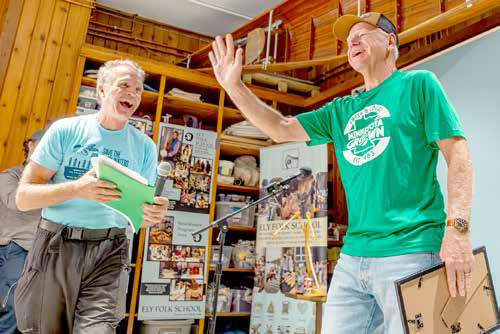
Walz visited the Ely Folk School and YMCA Camp Widjiwagan following the executive order’s signing.
Walz told listeners at Camp Widjiwagan that he believes the measures issued in the order will be “very, very difficult for anybody to unwind” due to many Minnesotans’ support for the ban.
Iron Range legislators, including one in the governor’s political party, indicated disapproval of copper-nickel mining restrictions, however. State Sen. Grant Hauschild (DFL-Hermantown) said he strongly opposes the executive order.
“Northern Minnesota deserves both a strong economy and clean water. Those values do not have to be in conflict. Most importantly, the people who live in our region deserve a meaningful voice in decisions that directly affect our communities, our environment and our economic future,” Hauschild said.
State Rep. Roger Skraba (R-Ely) called Walz’s move a devastating blow to the Iron Range.
“Politicians in St. Paul shouldn’t be picking winners and losers or deciding the outcome before the process is finished. Northlanders are tired of having our future decided for us by leaders who don’t understand our communities, our people, or our way of life. Let the review process work, let our communities have a voice, and let the chips fall where they may,” Skraba said.
Skraba said he believes a permanent ban could be a difficult sell in the legislature, especially if the state house remains evenly divided between DFL politicians and Republicans.
“(The Walz administration) could have run it all the way through this last time, but they didn’t. It doesn’t have legs,” Skraba said. “In my opinion, that bill is a fantasy.”
“We have been looking at the minerals within our deposit areas for the last 16 years,” says Dean DeBeltz, the vice president of external relations and project operations at Twin Metals. “We’ve invested over $600 million into this project to really understand the minerals. We’ve been working on the engineering of a project that will meet or exceed the requirements that are out there, to ensure that we can protect this area where we live. Twin Metals is about real people, it’s about real jobs.”
Walz’s recent move represents yet another question for the future of northern Minnesota’s copper-nickel industry, which aims to tap the world’s second-largest copper deposit.
Potential projects have sparked a heated back-andforth between mining advocates and opponents for years, generating lawsuits on both sides of the table.
The Biden administration implemented a 20-year block on mineral leasing across 225,378 acres of Superior National Forest Land in 2023, which was overturned by the Trump administration last April.